Some of the links in this post are affiliate links. This means if you click on the link and purchase the item, I will receive an affiliate commission at no extra cost to you. All opinions remain my own.
It’s been a while since I have done one of these, but a lot has changed. Since passing the ARE, I have gone on to obtain my architecture license (in 2 states), work as a principal architect, discipline lead and project manager. Project management and organization is definitely an interest of mine, if you can’t tell by my detailed breakdown and structure of my ARE exam process.
With this in mind, and also to improve my skills in the leadership of architecture projects, I decided to obtain the Project Management Institute (PMI) Project Management Professional Certification. I was initially aiming for the CAPM, which is for associates, since that appeared to be easier and faster, but in reviewing the material, I thought I would be better served in both effort and time to go straight to the PMP. Using the methods here, I was able to obtain Above Target on all 3 exam areas, Process, People and Business Environment.
In true RMSM Studio fashion, even though it is not specifically architecture related, I decided to share my materials and process in case anyone else was interested in going down this path. One thing that I did early on in the process was becoming a member of the PMI, which provides a substantial exam discount.
Application Process
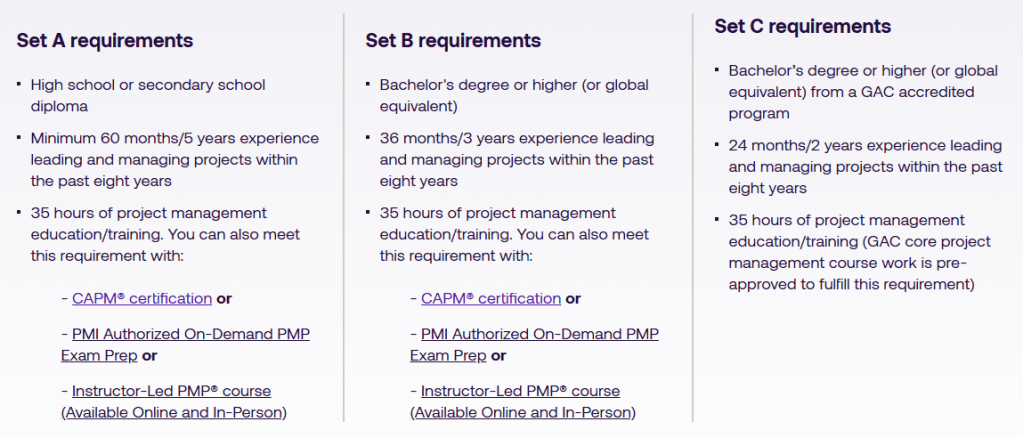
There are a number of paths towards the PMP, Set A, Set B, and Set C:
PMP Exam Requirements directly from the PMP website.
Most architecture professionals will fall under the Set B requirements, which is what I used. The creation of the project register for past experience was the most stressful part of this experience of this exam outside of the actual exam.
One of my big concerns was my project experience being audited, but the tips provided in Andrew Ramdayal’s course (more on that below) for this portion of the application were very helpful. I actually had more project experience than they required, but I decided to focus on presenting the most compelling and relevant projects to showcase the specific PM skills that I knew PMI was looking for.
It was interesting that after this course explained how the experience was proven and counted, I realized I could have sat for this exam several years earlier. There was nothing I could do at the time, but it leads me to recommend that you take this course as soon as possible, for this section alone, because you might be closer to being qualified than you think. You could shave off years waiting for the perfect portfolio of projects by understanding how experience is actually calculated.
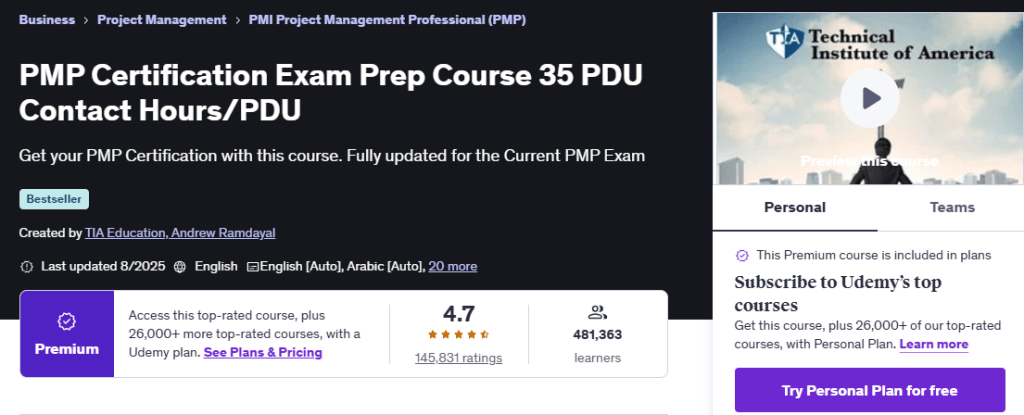
This is a premium course on Udemy, including the 35 hours of PDU as required by PMI above, but it is so much more than that. It teaches you the correct mindset to take with this exam, which is very similar to the ARE exam. Situations in this exam, even if you have experience and dealt with them in the real world, they still want you to apply the answers based on the ideal PMI mindset or process. This course discusses and hammers this home in a very helpful way.
Another great element of the course is that he provides a 30 day study plan, which I used as a guideline when I booked my exam with only a month to study. Trying to fit my social and personal life around studying was a real challenge. I tried to incorporate elements from my previous study time rules from the ARE exam, and it was helpful to already have that framework to reference.
I won’t refer to the price for this resource, as Udemy has different deals and promotions on a regular basis, but it is currently listed as $22.99.
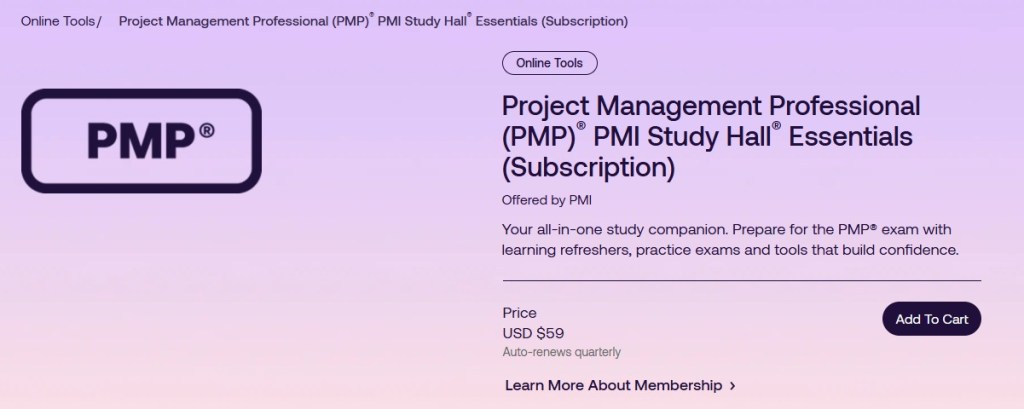
PMI Study Hall – Essentials only, focusing on the practice questions
I only took one PMI practice exam where I got 72%, and for the practice exams I scored around 70%
Rita Mulcahey PMP Text book, which I read through once. This book was recommended to me by MY project manager, as he said it was essentials to passing his exams.
Earned Value Management Video: Andrew Ramdayal created a video with tips on tips for memorizing the earned value management formulas. This is part of his course but I wanted to highlight this video specifically as being crucial to understanding the concept. He also has a version on Youtube, which I have linked to here.
Scrum Fieldbook: I felt weak in Agile practices so I got the Scrum Fieldbook, which had practical application of Scrum and Agile principles in the real world. I got my copy at the library for free, but it’s available for under $20 on Amazon.
Quizlet: I used 4 different Quizlet decks to assist with my studying. The goal with Quizlet is to keep drilling until you get everything right on a consistent basis. There is a great app, and this is a great way to study when you have a little pocket of time available during the day.
I tried to follow the Andrew Ramdayal study plan, but ended up taking a different path based on where I thought my gaps were. His course is very comprehensive, but I also realized that since I had been working in the industry a while, I needed to double down on what I was not familiar with. This is why I made a special effort with Scrum and memorizing some of the terminology and getting more deliberate and specific.
After the course’s Practice Exam I wrote down all the terms and concepts in the questions I got wrong and reviewed them. This is another technique I learned while studying for the ARE exam.
For the exam day itself, I had to drive almost 2 hours out to take the exam first thing in the morning. I was nervous that I would be thrown off by taking the exam in an unfamiliar place, but I would always rather take an exam in person. If anything goes wrong with my laptop, internet, or my general surroundings, I can instantly fail, through no fault of my own. I prefer to do it in a proctored environment and remove some variables. I brought my own snacks for the break and used the time to remain calm and stay grounded. I felt reasonably confident that I knew the material, but getting anxious would make my recall worse.
I ultimately ended up passing the exam with Above Target in all areas. I made sure to have a small celebration for myself to celebrate the win on a personal level. It has been a goal of mine to obtain my PMP since I was a kid (I know, weird dreams for a kid, but I really love managing), so it felt really satisfying to finally achieve it.
I wish you the best in your study journey, and all the success as you study for this exam.
Learn what study materials and methods I used to pass ARE 5.0 CE exam from NCARB on my second try.
Some of the links in this post are affiliate links. This means if you click on the link and purchase the item, I will receive an affiliate commission at no extra cost to you. All opinions remain my own.
CE was the first and only exam that I failed, so I thought this would be a great opportunity to share with you the differences between the first and second time that I took it. I believe that failing an exam doesn’t mean that you don’t know the material, but maybe you need to refocus your attention to fill you gaps.
As I shared in my CE Pass announcement there were many aspects of the exam that I was frustrated with, especially the lack of emphasis in the NCARB Handbook on the importance of studying construction details. I hope that you all can learn from my experience and that it helps move you forward in your exams.
Now let’s jump into the study materials…
Books
Kaplan ARE 4.0 Construction Documents and Services: For my first try, the major book that I used is actually the Kaplan CDS study guide. It explains a lot of basic concepts very well, some diagrams and is very good at explaining construction administration concepts. I purchased this textbook, along with the Questions and Answers, which I purchased from someone in the ARE Facebook Group.
Price: My version doesn’t appear to be for sale on Amazon, maybe check in the Facebook groups or Forums.
Architect’s Handbook of Professional Practice– I read this book mainly during my first try, focusing on chapter 9 and 10. here’s the Wiley Guide for the AHPP for Construction & Evaluation. I barely looked at the AHPP during my second attempt at this exam. I didn’t read as much AHPP as I did in ARE 5.0 Practice Management or Project Management. During my second attempt I spent a lot of time trying to focus on the contracts and construction details instead. I was able to get this book for free through my office.
Price:
$147 to rent hardcover per semester, subscription with extension option
$210 to buy hardcover, one time purchase
$208 to buy Kindle/e-book, one time purchase
Building Construction Illustrated Textbook – I only glanced at this book for my first try, like maybe a couple of hours which is definitely not enough for this exam. I went through the book and I had the digital version for that so what I would do is I would highlight all the relevant parts of the book which is very handy because then I could if I wanted to review a specific section all the important parts are already highlighted for me and it being a digital a resource you don’t have to worry about you know reselling the book or anything if you highlight and no one cares so that was very helpful tool for me another thing I also did to help with the sort of masterformat portions of the exam is building construction Illustrated also mentions the masked magicians each each section of the book so and it shows you something at all so tell you what part of masterformat it belongs to us I would highlight those as well so I get really familiar with how those things are organized what they look like.
Price:
Fifth Edition – $60
Sixth Edition Paperback – $36, one time purchase
Sixth Edition E-book – $42, one-time purchase
Hyperfine CE Course – My main technique for using this course for CE was to print it out and do the assignment by hand because it’s easier for me to go back and forth. This resource comes as digital files, but trying to do it as a digital assignment wasn’t working well for me.
Price: $30, one-time purchase
Contracts
NCARB covers a lot of contracts for the CE exam as you can see below. This exam actually includes the most contracts for you to review. I read through all of them. Don’t be intimidated by the number, since several of them are one-page documents.
My method for the contracts was:
Reading through the all actual contracts above at least once
Rewriting the contracts in shorthand as described in Christopher Richardson’s NCARB forum post
The Young Architect Contracts course was an essential reference for me for the Project Management exam. One of the biggest advantages of this course is that it goes through all of the contracts that are listed in the NCARB matrix, not just the B101 and A201. You can purchase this course separately from the CE exam, but I had purchased it for my previous exam.
The main contracts that I focused on were the A201 and the B101. The way that I studied them was both trying to write the contract out in my own words, and using the Schiff Hardin lectures. The lectures were the main way that I studied contracts at work. I don’t get much time doing my day to look at material, so I mostly focused on listening to the contracts.
I mainly focused on Schiff Hardin during my first attempt at this exam. I felt very comfortable with the contracts when I failed, so I didn’t use Schiff Hardin as much the second time. The other contracts I focused on for this exam were the G704, A305, the C401
Price:
Contracts: free on AIA website
Schiff Hardin Lectures: Free
Contract shorthand: free
Young Architects Contracts Course individually ($85), one-time purchase
Digital Resources
Quizlet – Full disclosure, I am not a big fan of physical flashcard decks. They’re a hassle to write and organize. I greatly prefer using digital flash cards for easy portability, I can save my spot in learning and test myself all within one app.
CSI Divisions Deck – It is important to be familiar with the common CSI divisions for this exam.
Building Construction Deck- This monster deck comes with pictures on over 400 cards, that allow you to study many different types of construction techniques and construction administration concepts.
ADA Flashcard Deck – It is important to be able to study ADA violations and measurements for this exam.
Price for all decks: Free
NCARB Forum – I also used the forum a lot for this exam. I always try to look at what other people have done, and what has or has not worked of the forums. However the element mentioned in the forum that I didn’t take it seriously was the construction portion of the exam. I thought it wasn’t as big of a part as it eventually ended up being. I thought I could just look at construction details for a couple of hours to get a general idea and I would be okay. That was not the case. So when someone says it something’s going to be on in the exam, that means it’s really important.
Young Architect Academy Construction & Evaluation 101 – this resource was helpful in terms of helping me understand Construction Administration and Project Management for this exam. This was studied in tandem with the Young Architect Academy AIA Contracts 101 course. The CE course is broken down to cover the specific objectives of this exam. The video format was very helpful and allowed me to study while I was working, or I can listen to it in the car. In addition to the audio from the videos, the course also has assigned readings and case studies.
Like all YAA courses, this course has a flat one-time fee and you can access it for as long as you like as opposed to paying for ongoing subscriptions if you fail. I only got this course for my second attempt at this exam.
Price: For CE 101 only, $99
Hammer & Hand Website– I didn’t spend as much time as I would have liked to on this resource on my first attempt at this exam. I really like the way that this website takes you through the creation of each detail, and shows you how the object is being built and layered. The overlapping of some items for example window details for sheathing, which are kind of difficult to understand in a regular section. So I really like the way that it’s done in 3D for better comprehension. This website was really great for understanding thermal protection and Foundation Construction. if you’re not familiar with these details I would say this is an essential reference.
XQ for ARE 5.0 App– This app was created by Kevin Griendling from Pluralsight. I really like using this for my second run of CE, because it allows you to answer questions in all four of exam formats, including hot spot and multiple choice. This is a subscription-based service so you have to decide how long you want to use the subscription for but I felt like this resource filled in a lot of the gaps in terms of tests addressing a construction detail questions so I thought it was very helpful for that reason. Many tests are good at talking about the construction Administration side not many practice exams focus on the construction detail side of course it makes it highly portable which is another great feature.
Price: $19.99, monthly subscription
YouTube Videos – This was another essential resource for me to understand details, construction administration, tests, common building practices, site safety, construction materials, and ADA information. I created an entire playlist just for the CE exam that you can access from this article or my YouTube page. Make sure to subscribe for more of my latest video content.
Price: Free
Practice Exams
Designer Hacks PjM Exam – I asked my office to purchase the full Designer Hacks practice questions for all 6 exams, since they were the same price as one physical textbook. Designer Hacks is super portable, with its mobile version, along with multiple levels from pop quizzes to full length timed exams. You can find my one-minute review for this resource here.
I like that I can break it into smaller portions. These questions are pretty easy so if you can’t take these questions then more complicated questions will not be possible, so these are always a good starting point. I really like using these questions when I have an extra bit of time like if I’m waiting in line or if I just have time to kill and I can whip it out on my phone and start doing practice questions.
Price: This item was free for me as described above, but for this course alone it is $39.
WEARE Website – I’ve found that this exam is slightly more difficult than the Designer Hacks, and allows me to cross-train with different questions. They are available in digital form, making them highly portable. One of my favorite parts of this resource is that they can be done as smaller portions, including short quizzes, and tests that can be separated into specific exam divisions. They also provide free versions of these questions, so you can see whether you are interested before you purchase.
Price: $34 per division, one-time purchase
Time Tracking Software
Clockify Website – I have really come to love this website, and it has been really helpful for me in seeing the difference between my two attempts at this exam. I use it to track my hours spent studying every day, and then can show you your total progress for your exam, and your progress for the week. You can use my study material tracker to list your hourly study goals for each resource
Price: Free
Flora App – This is a time tracking app that functions similar to a Pomodoro Timer, in that it tries to reduce distractions. While you have this app running, you can’t run other apps on your phone, which removes a major source of distraction for me. One of the great functions of Flora, is that for each section of time that you remain undistracted, you can grow a tree or flower, and create a garden, which I found to be really fun. This app also allows you to bet money against running your time undistracted, which goes towards tree planting if you fail.
Other Resources
I used the Ballast Practice Exam and Review Manual.
I read real specifications and project manuals to help me understand the Master Format Divisions
I downloaded full Construction Drawing set examples and went over them with my study group members. You need to look at every drawing individually in the set, and become familiar with them. This is especially critical for those who don’t have a lot of Construction Document experience.
Practice drawing actual build sections, like parapet walls, foundation details, column sections, window and door details.
Resources I Did Not Use
Black Spectacles – Not a lot of positive reviews and extremely expensive. I wish they broke their program into the individual parts as it would be useful to try their demo exam independent of their other offerings.
Pluralsight – since Pluralsight’s PjM course is mostly contracts, I didn’t want to purchase both this and the YA Contracts course.
AEP – expensive, and not enough positive reviews to purchase
Amberbooks – I didn’t get Amberbooks for this exam, but I may use it if I don’t pass my upcoming PPD and PDD exams.
Young Architect Bootcamp – If I am thinking of possibly investing in this for the final 3 technical exams, if I don’t pass my two technical exams. I’m still trying to remain mostly self-guided for as long as I can.
In Conclusion
I was so nervous when I went into my second attempt at this exam, but I felt very confident with the amount of work I had done to catch up on my construction detail sections. If you want to find out more of my impressions immediately after my exam, you can see my article on it here.
ARE Master Material List
The Master Material List was a list and resource I put together to provide a comprehensive, one-stop solution for those trying to buy and understand ARE study materials. The list shows the material formats, the exams each one was used for, rental options, and prices. I have also included free materials I used within this list. You can get your copy here for free, and read along with the video replay of the live session.