PMP Pass: Study Materials and Methods

Some of the links in this post are affiliate links. This means if you click on the link and purchase the item, I will receive an affiliate commission at no extra cost to you. All opinions remain my own.


It’s been a while since I have done one of these, but a lot has changed. Since passing the ARE, I have gone on to obtain my architecture license (in 2 states), work as a principal architect, discipline lead and project manager. Project management and organization is definitely an interest of mine, if you can’t tell by my detailed breakdown and structure of my ARE exam process.

With this in mind, and also to improve my skills in the leadership of architecture projects, I decided to obtain the Project Management Institute (PMI) Project Management Professional Certification. I was initially aiming for the CAPM, which is for associates, since that appeared to be easier and faster, but in reviewing the material, I thought I would be better served in both effort and time to go straight to the PMP. Using the methods here, I was able to obtain Above Target on all 3 exam areas, Process, People and Business Environment.

In true RMSM Studio fashion, even though it is not specifically architecture related, I decided to share my materials and process in case anyone else was interested in going down this path. One thing that I did early on in the process was becoming a member of the PMI, which provides a substantial exam discount.

Application Process

There are a number of paths towards the PMP, Set A, Set B, and Set C:
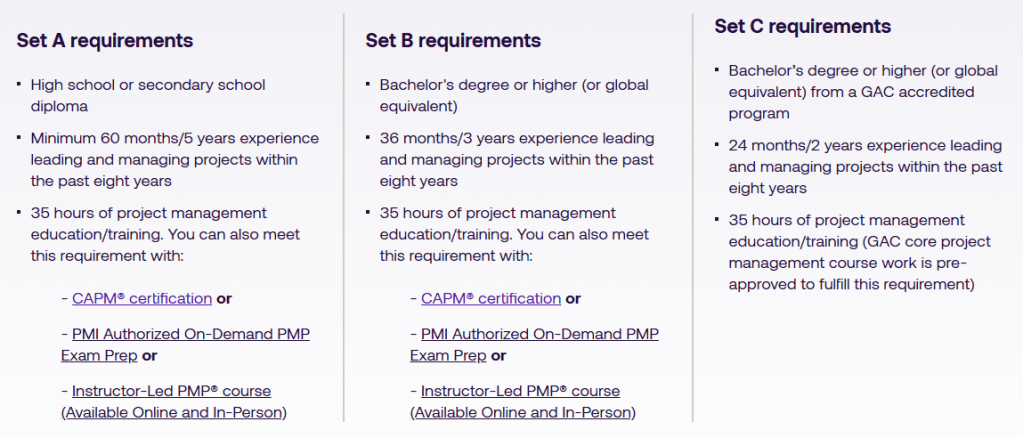
PMP Exam Requirements directly from the PMP website.

Most architecture professionals will fall under the Set B requirements, which is what I used. The creation of the project register for past experience was the most stressful part of this experience of this exam outside of the actual exam.

One of my big concerns was my project experience being audited, but the tips provided in Andrew Ramdayal’s course (more on that below) for this portion of the application were very helpful. I actually had more project experience than they required, but I decided to focus on presenting the most compelling and relevant projects to showcase the specific PM skills that I knew PMI was looking for.

It was interesting that after this course explained how the experience was proven and counted, I realized I could have sat for this exam several years earlier. There was nothing I could do at the time, but it leads me to recommend that you take this course as soon as possible, for this section alone, because you might be closer to being qualified than you think. You could shave off years waiting for the perfect portfolio of projects by understanding how experience is actually calculated.

Study Materials

PMP Certification Exam Prep Course 35 PDU Contact Hours/PDU – Udemy course by Andrew Ramdayal (TIA Education)
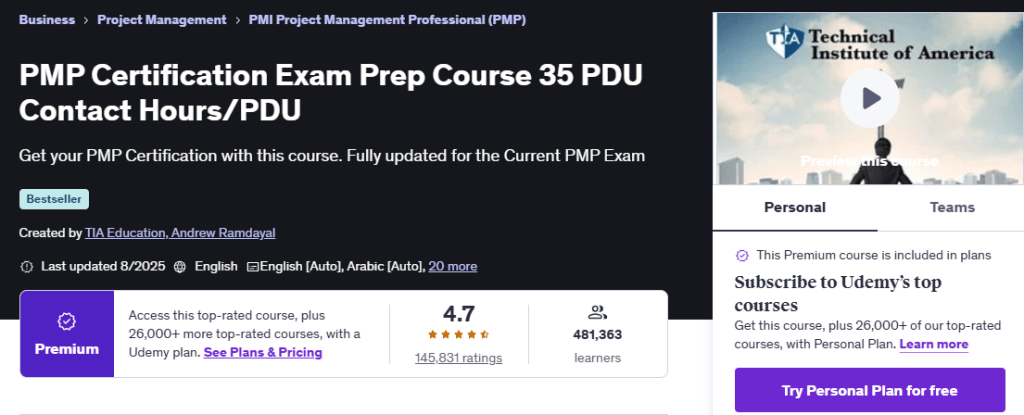
This is a premium course on Udemy, including the 35 hours of PDU as required by PMI above, but it is so much more than that. It teaches you the correct mindset to take with this exam, which is very similar to the ARE exam. Situations in this exam, even if you have experience and dealt with them in the real world, they still want you to apply the answers based on the ideal PMI mindset or process. This course discusses and hammers this home in a very helpful way.

Another great element of the course is that he provides a 30 day study plan, which I used as a guideline when I booked my exam with only a month to study. Trying to fit my social and personal life around studying was a real challenge. I tried to incorporate elements from my previous study time rules from the ARE exam, and it was helpful to already have that framework to reference.

I won’t refer to the price for this resource, as Udemy has different deals and promotions on a regular basis, but it is currently listed as $22.99.
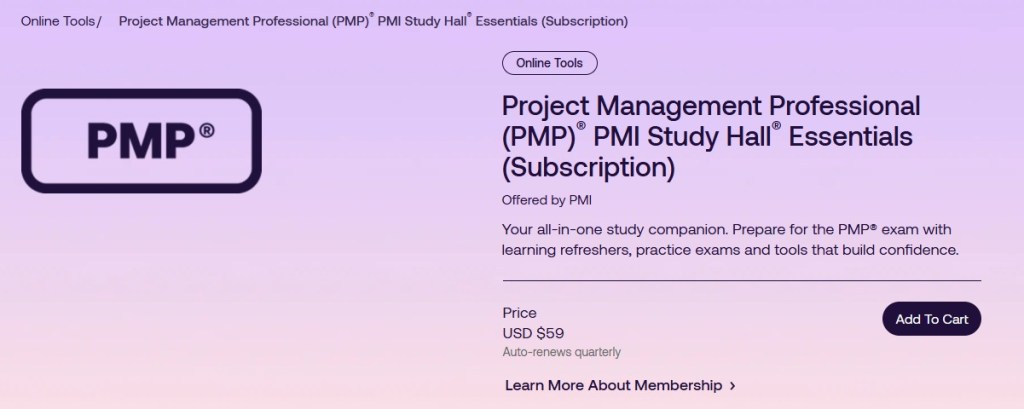
PMI Study Hall – Essentials only, focusing on the practice questions

I only took one PMI practice exam where I got 72%, and for the practice exams I scored around 70%

Rita Mulcahey PMP Text book, which I read through once. This book was recommended to me by MY project manager, as he said it was essentials to passing his exams.

Earned Value Management Video: Andrew Ramdayal created a video with tips on tips for memorizing the earned value management formulas. This is part of his course but I wanted to highlight this video specifically as being crucial to understanding the concept. He also has a version on Youtube, which I have linked to here.

Scrum Fieldbook: I felt weak in Agile practices so I got the Scrum Fieldbook, which had practical application of Scrum and Agile principles in the real world. I got my copy at the library for free, but it’s available for under $20 on Amazon.

Quizlet: I used 4 different Quizlet decks to assist with my studying. The goal with Quizlet is to keep drilling until you get everything right on a consistent basis. There is a great app, and this is a great way to study when you have a little pocket of time available during the day.

PMP ITTO Rules and Patterns

Equations PMP

PMP Exam

PMP: Documents

Overview

I tried to follow the Andrew Ramdayal study plan, but ended up taking a different path based on where I thought my gaps were. His course is very comprehensive, but I also realized that since I had been working in the industry a while, I needed to double down on what I was not familiar with. This is why I made a special effort with Scrum and memorizing some of the terminology and getting more deliberate and specific.

After the course’s Practice Exam I wrote down all the terms and concepts in the questions I got wrong and reviewed them. This is another technique I learned while studying for the ARE exam.

For the exam day itself, I had to drive almost 2 hours out to take the exam first thing in the morning. I was nervous that I would be thrown off by taking the exam in an unfamiliar place, but I would always rather take an exam in person. If anything goes wrong with my laptop, internet, or my general surroundings, I can instantly fail, through no fault of my own. I prefer to do it in a proctored environment and remove some variables. I brought my own snacks for the break and used the time to remain calm and stay grounded. I felt reasonably confident that I knew the material, but getting anxious would make my recall worse.

I ultimately ended up passing the exam with Above Target in all areas. I made sure to have a small celebration for myself to celebrate the win on a personal level. It has been a goal of mine to obtain my PMP since I was a kid (I know, weird dreams for a kid, but I really love managing), so it felt really satisfying to finally achieve it.

I wish you the best in your study journey, and all the success as you study for this exam.

How to Use Flashcards for the ARE

Flashcards are an amazing tool for people working on gaining a better understanding of subjects and detailed information. However, creating them can be a time consuming task, almost bordering on procrastination if not approached with efficiency in mind.

Let me show you the ways that I use flash card decks to avoid wasting time and focus on the relevant information in my new video on YouTube.

Don’t forget to subscribe to my YouTube Channel to get access to more ARE content!

PDD Mega Playlist Now on YouTube!

Some of the links in this post are affiliate links. This means if you click on the link and purchase the item, I will receive an affiliate commission at no extra cost to you. All opinions remain my own.


I just finished my last exam PDD! The blog post for the materials I used is coming shortly, but I did a short post on it within the ARE Studio Facebook Group if you want to take a sneak peek. If you are not a member of the ARE Studio | Study For & Pass the ARE group yet, make sure to answer all the membership questions to get accepted.

This new PDD Mega Playlist is the result of my two attempts at PDD, with over 450 videos! I created this playlist for my first take of the exam, and after I failed, I kept adding on to it with the new material I learned to fill in my gaps. Some of these videos are very comprehensive, such as the ones from the Construction Specifications Institute (CSI), from 45 minutes to an hour long. I really like using long videos while I work, as they become like Schiff Hardin Lectures for me.

Another video medium that I made use of, which is not included in the YouTube Playlist, are the Construction 144 Grant Adams lectures that you can find on Vimeo. Again, I used these as Schiff Hardin lectures, and listened to them in the background all day. These videos are basically a building materials and structures course, broken down by the different material types, and I think a lot of the content comes from the Fundamentals of Building Construction: Material and Methods textbook.

I hope you find these resources helpful, and make sure to subscribe to my YouTube channel to get more updates on ARE 5.0 content like this. Good luck on your exams!

Ways To Reset Your Study Process After the Holidays

Trying to get your motivation back after the holiday season? Use these tips to get back on the wagon.

Happy New Years Everyone! I don’t know about you, but I may have been a bit ambitious in my productivity expectations for the month of December. I didn’t have family visiting, and I hadn’t made extensive social plans, but I still ended up studying way less than I had originally planned. It’s really easy to get bogged down with feelings of guilt and ineffectiveness at times like this, but I decided to reset my thinking instead and shift my focus. You can take advantage of these tips as well, and let me know in the comments if any of these tips work for you.

Book an Exam

I have found that I work best under a deadline. As I’ve shared in my past videos, my entire study process changed when I bought my first exam seat in 2020. My energy, focus and priorities changed. Even though I am taking PPD in a few weeks, I decided to go ahead and buy a seat for PDD a month afterwards. This will allow me to keep up the momentum, whether I pass PPD or not, and stop me from losing focus if I do fail.

Connect With Your Study Buddies

I have both an accountability and study group for my upcoming exams, both of which I meet with once a week. In my first session with my accountability partner, she reminded me that everyone tends to fall off during the holiday season, and that it’s normal to fall behind during these times. It was great to hear that, since I tend to hold myself to very high expectations.

Connecting with other people going through the same thing as you will give a fresh perspective and understanding that we’re all going through the same struggles. It will also help you figure out how to move forward in spite of your setbacks, with a second set of eyes that can sometimes see a solution that you can’t.

Reorganize Your Calendar

One of my favorite concepts/thought exercises is this:

  1. Write down your top 3 priorities in life
  2. Open Up Your Calendar
  3. Check Where Your Priorities Show Up in Your Calendar

I love doing this exercise, because it really forces me to put my money where my mouth is in terms of organizing my time around the things I say are important to me. Long story short, if you say passing your exams is a priority for you this year, then your study time, exam dates, and study group meetups need to all be blocked off (marked as “Busy”) on your calendar.

For me, this helps avoid double booking myself, promising someone I will attend an event or a meeting when I’m supposed to be studying. This also helps me keep a regular routine, and build a consistent study habit. I did not have my study times marked out this December, which I hold partially responsible for my loss of focus.


Did you experience the same problems that I did this holiday season? If you did, let me know in the comments, and how you plan to overcome them. If you’re interested in receiving more updates and content from me, make sure to sign up for my mailing list.

ARE 5.0 CE & PA Video Playlists: An Essential Resource

Hey everyone, I wanted to share these playlists with everyone, since I have finally been able to upload all the videos into my official YouTube study playlists for the Construction & Evaluation and Programming & Analysis exams.

I was able to pass PA on the first try this week, and doing so finally gave me the free time to catch up on some items I’ve had on the backburner.

Both of these playlists are based on the actual videos I used to study for and pass both ARE 5.0 CE & PA recently. There are over 100 videos in each, from a variety of lecturers, companies, ARE test prep providers, and more, explaining essential concepts for these exams.

Construction & Evaluation Playlist

I took CE twice because I was unclear on what exactly the scope of the exam was. They always say that the ARE is the best practice exam. Once I had a better grasp on what the exam involved, I felt better able to conquer my gaps, and redirect my studying. Here are the videos that helped me pass this exam on my second try.

RMSM Studio ARE 5.0 CE Playlist

Programming & Analysis Playlist

I am so excited about passing PA this week! This test was so challenging just because of the shear quantity of topics that you have to cover and understand. Imagine having to know about soil types and egress calculations all on the same test! But one thing I would keep in mind is that at the end of the day with this exam, it is truly about understanding the larger concepts, so you can apply them in your every day practice.

That’s why these videos were so valuable for me. It wasn’t about memorizing the details of a particular topic, it was about having a good understanding of the information, so if you had to apply it to a project (or in this case, a case study), you would know what to do.

MSM Studio ARE 5.0 PA Playlist

I hope you find these playlists helpful, I hope to be releasing the detailed list of study materials and techniques for both of these tests soon.

I Passed Construction and Evaluation!

My challenges with the Construction & Evaluation Exam.

I got the official score report from NCARB last night, so excited to share that I passed CE this Tuesday! I was really nervous about this exam, since it had been my only fail so far, and I did NOT want to pay that $235 again. My major challenges for this test were:

  • A definite lack of clarity from NCARB’s side on the inclusion of the construction & detail sections of this exam, for examples, details, sections, etc, that they showed in the Handbook practice questions, but not in their reference lists.
  • Struggling to read these contracts all over again. When I feel like I know something already, my brain starts to shut it out, because it feels like I already know this information. But rereading and rewriting the contracts was definitely helpful for me.
  • A lack of practice questions that dealt with those construction sections that I mentioned above, but I’ll be sharing some resources I found in my normal detailed blog post that I do after every passed exam.
  • Figuring out what was or was not important in terms of contracts. Do I need to memorize all the contract times and time limits, or is that going too deep? I know there’s no such thing as over-studying for this exam, but I felt like sometimes I was focusing on the wrong things. At some point my study group found a video on deciphering welding symbols, and we were like, you never know, this might come up!
  • Worrying about any distractions and the effect it will have on my exam result. I decided to pursue my LEED Green Associate credential (which I got) as an additional certification that I can use for work. I’m already a Green Star accredited professional in Namibia and South Africa, but I felt like I needed the certification in the U.S. as well. But I was really worried that the two weeks I took off to study for the LEED Green Associate exams would make or break me for CE.
  • Do I need more experience in residential construction? A lot of the projects that I’ve worked on have been institutional, educational, healthcare, and I’ve never worked on a building that used wood structure before. I was worried that the lack of experience in this specific area would hurt me in the exam, but my study group made sure to look at examples of actual construction sets, so i was at least familiar with how things would actually look, and of course, there are the textbooks that cover those things as well.
  • What will my timeline be like if I fail? I’m currently trying to take and pass all of my exams before NCARB transitions into the new testing provider PSI. If I failed CE, would I have to further delay taking my PPD and PDD? Luckily it didn’t come to that, but it was a genuine worry that I had.
  • Do you know this famous quote from Muhammad Ali?

This is me right now. I hate studying so much! I feel like I watched summer pass me by through the window by my desk. This test takes so much out of you in terms of time and mental load, and it bothers me that I feel like I can’t be fully present for my family and friends. But I think that the end result is definitely worth it.

Overall, I would say that I’m super happy and relieved that I have this exam under my belt, and ecstatic that I am halfway through this process. I am trying to make sure that this time I intentionally celebrate my win, and properly rest before I dive into PA. Stay tuned for my detailed blog post, and I wish you guys all the best in your ARE journey’s as well. If you have any specific questions about CE, make sure to ask me in the comments, and I may be able to address them in my upcoming blog post.

I Passed PJM!

So excited to announce that I passed my project management exam just last week. This is another great step forward in my ARE journey, and thank you for following me this far. I’m still getting over my post-exam jitters. I will be sharing my detailed study list and study methods in a few days. Keep your eyes peeled for my detailed study materials blog post, try out some of my PjM practice questions, and happy studying!

Practice Question: Quality Management

As I continue to study for ARE 5.0 Project Management, one of the areas I struggle with the most is Quality Management, but not for the reason you might think. For me, a lot of the concepts seem so obvious that it’s difficult for me to retain. So I’ll be reading it, agreeing with everything it says, but not retaining any specifics. So I’ve been trying to work on that in ways that will stay in my memory. Videos like the one below, and other tools are great visual aids to help me retain those details.

Practice Problem: Quality Management

Which of these items are not elements of a Quality Management (QM) in Construction Procurement?

  • Effective In-House Procurement Protocol
  • Beneficial Support Resources
  • Constant Monitoring and Documentation
  • Document Access and Control

Correct Answer

Document Access and Control is an Element of Quality Management in Construction Administration.

Wrong Answers

All of these items are Elements of Quality Management in Construction Procurement:

  • Effective In-House Procurement Protocol
  • Beneficial Support Resources
  • Constant Monitoring and Documentation

For reference for this question, check out AHPP Chapter 12.4.


Let me know how you did on this question, and make sure to follow RMSM Studios on Facebook and Instagram!

Practice Question: Utilization Rates

ARE 5.0 Project Management (PjM) Practice Question on firm utilization rates.

Utilization Rates are an important part of how firms track the hours spent on direct versus indirect labor, and are considered one of the 7 Key Financial Performance Indicators for architecture firms. I created this practice problem using the concept and real ways that it might change over time. Hyperfine is a great resource for practice questions and examples on both practice and project management concepts, as part of their Financial Formulas Workbook and their ARE 5.0 Courses.

Here’s a video of them going through a set of utilization rate questions.

Practice Question: Utilization Rates

The image below shows the salaries and utilization rates for the previous year for SKY Architects.

The salaries and utilization rates for this year are expected to be exactly the same, with the following changes:

  • Baboucar will be on paid paternity leave for 3 months
  • Yandeh will only be working part-time to pursue her graduate degree in historic presentation. Her utilization rate will be cut in half.

With these changes in mind, calculate the following:

  1. Estimated annual direct labor budget
  2. Yandeh R.’s estimated annual direct labor hours

Correct Answers

Question 01

In order to calculate the estimated annual budget we first need to calculate the direct labor budget for each member of staff:

  • Samuel: $170,000 * 0.5 = $85,000
  • Jeoffrey: $60,000 * 0 = $0
  • Yandeh: $90,500 salary, utilization rate = 0.8 * 0.5 = 0.4, so Yandeh’s direct salary this year will be $90,500 * 0.4 = $36,200
  • Fatou:$90,500 * 0.9 = $81,450
  • Baboucar: $70,000 salary, but he will only be working for 9 months out of 12, so we calculate 9/12 of his salary or 75%. So $70,000 * 0.75 = $52,500. With a consistent utilization rate of 0.9, his direct salary is $52,500 * 0.9 = $47,250

If we add up all of these direct salaries, we get $249,900.

Question 02

In order to calculate Yandeh’s estimated direct labor hours, we first need to determine hours per year. The number of hours in a year is 2080. Her current utilization rate is 80% but with her new graduate program, her utilization rate is reduced to 40% for this year.

So we would calculate 2080 hours * 0.4 = 832 direct labor hours this year.


Let me know how you did on this question, and make sure to follow RMSM Studios on Facebook and Instagram! Feel free to look through my blog for additional PjM Practice Questions and Mini Quizzes. You can search by tags, or by categories. If you have any questions, or you want to tell me how you did, leave a comment on the blog or on my Facebook page.

Practice Question: ADA

ARE 5.0 Practice question from RMSM Studio on the Americans with Disabilities Act (ADA, which is celebrating its 30 year anniversary!

Some of the links in this post are affiliate links. This means if you click on the link and purchase the item, I will receive an affiliate commission at no extra cost to you. All opinions remain my own.

Try your hand at this practice problem I created today based on the Americans with Disabilities Act (ADA), which had its 30th anniversary this week! Though this is something we study as a mandatory code to be enforced in architecture and the ARE specifically, it’s still important to remember the impact this legislation has on the lives of people everyday. You can also check out these great videos from Archicorner as a study reference for ADA design. Here’s a great video from them on the differences between ADA and Building Code Accessibility.

Here’s an additional great article from ArchDaily, which provides a simple guide to using ADA standards.

Practice Problem: ADA

The ADA prevents discrimination based on which of the following:

  • Discrimination based on gender, for employers with 15+ employees
  • Discrimination based on disability, regardless of employer size
  • Discrimination based on age, for employers with 20+ employees
  • Discrimination based on disbility, for employers with 15+ employees

ARE 5.0 Practice question from RMSM Studio on the Americans with Disabilities Act (ADA, which is celebrating its 30 year anniversary!

Correct Answer

Discrimination based on disability, for employers with 15+ employees.

Wrong Answers

The Civil Right Act, Title VII prevents discrimination based on gender, race color, religion, national origin and sexual orientation for employers with 15+ employees.

ADA prevents discrimination based on disability specifically for employers with 15+ employees.

ADEA (Age Discrimination in Employment Act) prevents discrimination based on age.


Let me know how you did on this question, and make sure to follow RMSM Studios on Facebook and Instagram! For more practice questions you can check out my mini quizzes, or some of the awesome practice exams created by Designer Hacks (which I just used today, got a 77% lol) and the Walking the ARE Practice Exams. As always, happy studying!