Practice Question: Utilization Rates

ARE 5.0 Project Management (PjM) Practice Question on firm utilization rates.

Utilization Rates are an important part of how firms track the hours spent on direct versus indirect labor, and are considered one of the 7 Key Financial Performance Indicators for architecture firms. I created this practice problem using the concept and real ways that it might change over time. Hyperfine is a great resource for practice questions and examples on both practice and project management concepts, as part of their Financial Formulas Workbook and their ARE 5.0 Courses.

Here’s a video of them going through a set of utilization rate questions.

Practice Question: Utilization Rates

The image below shows the salaries and utilization rates for the previous year for SKY Architects.

The salaries and utilization rates for this year are expected to be exactly the same, with the following changes:

  • Baboucar will be on paid paternity leave for 3 months
  • Yandeh will only be working part-time to pursue her graduate degree in historic presentation. Her utilization rate will be cut in half.

With these changes in mind, calculate the following:

  1. Estimated annual direct labor budget
  2. Yandeh R.’s estimated annual direct labor hours

Correct Answers

Question 01

In order to calculate the estimated annual budget we first need to calculate the direct labor budget for each member of staff:

  • Samuel: $170,000 * 0.5 = $85,000
  • Jeoffrey: $60,000 * 0 = $0
  • Yandeh: $90,500 salary, utilization rate = 0.8 * 0.5 = 0.4, so Yandeh’s direct salary this year will be $90,500 * 0.4 = $36,200
  • Fatou:$90,500 * 0.9 = $81,450
  • Baboucar: $70,000 salary, but he will only be working for 9 months out of 12, so we calculate 9/12 of his salary or 75%. So $70,000 * 0.75 = $52,500. With a consistent utilization rate of 0.9, his direct salary is $52,500 * 0.9 = $47,250

If we add up all of these direct salaries, we get $249,900.

Question 02

In order to calculate Yandeh’s estimated direct labor hours, we first need to determine hours per year. The number of hours in a year is 2080. Her current utilization rate is 80% but with her new graduate program, her utilization rate is reduced to 40% for this year.

So we would calculate 2080 hours * 0.4 = 832 direct labor hours this year.


Let me know how you did on this question, and make sure to follow RMSM Studios on Facebook and Instagram! Feel free to look through my blog for additional PjM Practice Questions and Mini Quizzes. You can search by tags, or by categories. If you have any questions, or you want to tell me how you did, leave a comment on the blog or on my Facebook page.

Practice Question: ADA

ARE 5.0 Practice question from RMSM Studio on the Americans with Disabilities Act (ADA, which is celebrating its 30 year anniversary!

Some of the links in this post are affiliate links. This means if you click on the link and purchase the item, I will receive an affiliate commission at no extra cost to you. All opinions remain my own.

Try your hand at this practice problem I created today based on the Americans with Disabilities Act (ADA), which had its 30th anniversary this week! Though this is something we study as a mandatory code to be enforced in architecture and the ARE specifically, it’s still important to remember the impact this legislation has on the lives of people everyday. You can also check out these great videos from Archicorner as a study reference for ADA design. Here’s a great video from them on the differences between ADA and Building Code Accessibility.

Here’s an additional great article from ArchDaily, which provides a simple guide to using ADA standards.

Practice Problem: ADA

The ADA prevents discrimination based on which of the following:

  • Discrimination based on gender, for employers with 15+ employees
  • Discrimination based on disability, regardless of employer size
  • Discrimination based on age, for employers with 20+ employees
  • Discrimination based on disbility, for employers with 15+ employees

ARE 5.0 Practice question from RMSM Studio on the Americans with Disabilities Act (ADA, which is celebrating its 30 year anniversary!

Correct Answer

Discrimination based on disability, for employers with 15+ employees.

Wrong Answers

The Civil Right Act, Title VII prevents discrimination based on gender, race color, religion, national origin and sexual orientation for employers with 15+ employees.

ADA prevents discrimination based on disability specifically for employers with 15+ employees.

ADEA (Age Discrimination in Employment Act) prevents discrimination based on age.


Let me know how you did on this question, and make sure to follow RMSM Studios on Facebook and Instagram! For more practice questions you can check out my mini quizzes, or some of the awesome practice exams created by Designer Hacks (which I just used today, got a 77% lol) and the Walking the ARE Practice Exams. As always, happy studying!

Mini Quiz: Project Management

Mini Quiz from RMSM Studio on the Project Planning and Management

I’ve created these questions based on the Ballast Review Manual, which you can find for on Amazon, or search for a used version in the ARE Facebook Group. The Ballast Review Manual comes very highly recommended for multiple ARE exams, and you can check out the Young Architect website for a 15% off discount from PPI2Pass.

Question 01

Within the Critical Path Method (CPM), which items are denoted by a solid arrow?

  • Dummies
  • Tasks
  • The Critical Path
  • Dependencies

Question 02

Which elements form part of the project work plan? (Select all that apply)

  • Allocation of time and fees
  • Staff Required
  • Instruments of service
  • Milestones
  • Contingencies
  • Consultant work and fees

Question 03

Architects should consider the follow issues when assembling a project team, except for: (Select one)

  • Billing Rates
  • Project Size and Complexity
  • Personalities
  • Contractor Experience

Question 04

What is the typical fee percentage for Design Development?

  • 15%
  • 20%
  • 30%
  • 40%

Question 01

Within the Critical Path Method (CPM), which items are denoted by a solid arrow?

  • Tasks

Dummies are represented by dashed arrows, as opposed to the heavy dashed arrows which show the Critical Path. Dummies are another name for Dependencies.

Ballast, page 4-6

Question 02

Which elements form part of the project work plan? (Select all that apply)

  • Allocation of time and fees
  • Staff Required
  • Milestones
  • Consultant work and fees

Though the project can be broken down into phases and individual tasks, the instruments of service themselves are not an element of the project work plan.

Although time and fees allocated to the project can both include contingencies, contingencies themselves are not an element of the project work plan.

Ballast, page 4-8

Question 03

Architects should consider the follow issues when assembling a project team, except for: (Select one)

  • Contractor Experience

Architects do not make the selection for contractors, though contractors can be a part of the overall project team.

Ballast, page 4-4

Question 04

What is the typical fee percentage for Design Development?

  • 20%

On a typical design-bid-build project, the fee percentages are as follows:

Schematic Design: 15%

Design Development: 20%

Construction Documentation: 40%

Bidding: 5%

Contract Administration: 20%

Ballast, page 4-9


I hope you like this mini quiz. Let me know how you did in the comments, or on the RMSM Studio Facebook page. If you got none of them right, it’s time to hit the books!

If you’re studying for Project Management, feel free to check out my other Mini Quiz on the A201, and if you’re studying for Construction & Evaluation, check out my Mini Quiz on C401.

If you want to find other great practice tests, you can also have a look at my One Minute Reviews, where I give my feedback on ARE study materials in under a minute.

Mini Quiz: A201

A 4 question quiz on the General Conditions of the Contract for Construction. The answers are provided after the questions. The A201 contract is available as a free download from the AIA website, and I’m currently studying it in preparation for my upcoming Project Management (PjM) and Construction & Evaluation (CE) Exam. It is listed within the ARE 5.0 Reference Matrix as a study material for PjM. Good luck studying, and if you have any questions, let me know in the comments!

Question 01

When does the Owner not have to share information about their financial arrangements for the Work?

  • Prior to the commencement of the work
  • When the Owner fails to make payments as per the contract documents
  • When a change in the work materially changes the contract sum
  • When the Architect issues a Certificate for Payment

Question 02

A Modification is all of the following, except for a: (Choose 1)

  • Construction Change Directive
  • Written Order for a minor change in work issued by the Owner
  • Change Order
  • Written Amendment to the Contract signed by both parties

Question 03

The Contractor shall immediately suspend any operations if they encounter the following conditions, except for:

(Choose 1)

  • Wetlands
  • Archaeological Sites
  • Burial Markers
  • Contract Documents in violation of applicable laws

Question 04

Select all items provided and paid for by the Contractor:

  • Sales Tax
  • Approvals for Occupancy
  • Temporary facilities not incorporated in the work
  • Utilities
  • Equipment and Machinery
  • Transportation

Question 01

When does the Owner not have to share information about their financial arrangements for the Work?

Correct Answers

  • When the Architect issues a Certificate for Payment

Incorrect Answers

Prior to the commencement of the work – Article 2.2.1 Prior to commencement of work and upon written request of the contractor, the owner shall furnish to the contractor evidence that the owner has made financial arrangements

When the Owner fails to make payments as per the contract documents & When a change in the work materially changes the contract sum – See Article 2.2.2

Question 02

A Modification is all of the following, except for a: (Choose 1)

Correct Answer

  • Written Order for a minor change in work issued by the Owner – Owners do not issue minor changes in work, those are issue by the Architect

Incorrect Answers

Construction Change Directive, Change Order, and a Written Amendment to the Contract signed by both parties: are all listed under Article 1.1.1 as Modifications.

Question 03

The Contractor shall immediately suspend any operations if they encounter the following conditions, except for:

Correct Answer

  • contract documents in violation of applicable laws – Article 3.2.3 The Contractor is not required to suspend work upon discovery of a nonconformity of the Contract Documents, only required to promptly report to the Architect

Incorrect Answers

According to Article 3.7.5 if the COntractor discovers any of these conditions, they shall immediately suspend operations:

  • Wetlands
  • Archaeological sites
  • Burial markers

Question 04

Select all items provided and paid for by the Contractor:

Correct Answer

  • Sales Tax – Article 3.6 Taxes
  • Temporary facilities not incorporated in the work – Article 3.4.1
  • Utilities – Article 3.4.1
  • Equipment and Machinery – Article 3.4.1
  • Transportation – Article 3.4.1

Incorrect Answers

All other items are to be provided by the Contractor.

  • Approvals for Occupancy – Provided by the owner as per Article 2.3.1

Thanks for taking part in my quiz, let me know how you did in the comments! You can also check out my mini quiz for C401 or check out my reviews for other practice exam providers.

Mini Quiz: C401

A 4 question quiz on the Agreement between the Architect and Consultant. The answers are provided after the questions. The C401 contract is available as a free download from the AIA website, and I’m currently studying it in preparation for my upcoming Project Management (PjM) Exam. It is listed within the ARE 5.0 Reference Matrix as a study material for PjM. Good luck studying, and if you have any questions, let me know in the comments!

Question 01

Select all four parties identified in the C401:

  • Architect
  • Owner
  • Contractor
  • Sub-consultants
  • Architect’s Other Consultants
  • Surety
  • Consultant
  • Subcontractors

Question 02

Which statements are true of consultant’s services?

  • COnsultant has the ability to reject work under their scope
  • Architect ascertains requirements for the Consultant’s portion of the work
  • Consultants shall render written decisions on claims and disputes relating to the execution of their portion of the scope
  • Consultant shall notify the architect of the need for additional services

Question 03

The Architect must provide the following information except for:

(Choose 1)

  • detailed layouts showing locations of connections
  • tabulations giving equipment sizes
  • the architect’s compensation within the prime agreement
  • investigations of other consultants not within the scope of the consultants services

Question 04

Select all methods of binding dispute resolution between an Architect and their Consultant:

(Choose 2)

  • Arbitration
  • Mediation
  • Professional Ethics Council
  • Litigation

Question 01

Select all four parties identified in the C401:

Correct Answers

  • Architect – Identified on the first page of the Agreement
  • Owner – Identified on the first page of the Agreement
  • Sub-consultants- Identified in Article 1.9
  • Consultant – Identified on the first page of the Agreement

Incorrect Answers

None of the other parties are specifically identified and named within this agreement.

Question 02

Which statements are true of consultant’s services?

Correct Answer

  • Consultant shall notify the architect of the need for additional services (Article 4.1)

Incorrect Answers

Article 3.1.5 Consultant does not have the ability to reject any work on the project, they can assist the architect in determining if work should be rejected

Article 3.1.1 Consultant shall ascertain the requirements for this portion of the work and shall confirm such requirements with the architect.

Article 3.1.4 Consultants don’t have the power to render decisions on disputes, they can however issue written recommendations on claims, disputes, and other matters in question relating to the execution or progress of their portions of the work.

Question 03

The Architect must provide the following information except for:

Correct Answer

  • the architect’s compensation within the prime agreement – Article 1.1, a copy of the prime agreement(from which compensation amounts maybe deleted) is attached as Exhibit A and is made a part of this Agreement

Incorrect Answers

Article 5.3 The Architect shall furnish to the Consultant detailed layouts showing locations of connections, tabulations giving equipment sizes, loads and other information on equipment designed.

Article 5.7 If the Consultant reasonably requests information from investigations, survey,s, tests, analyses or reports, or the services of other consultants not within the scope of the consultant’s services, the Architect shall request that the Owner furnish the information or services.

Question 04

Select all methods of binding dispute resolution between an Architect and their Consultant:

Correct Answers

  • Arbitration – Article 8.2
  • Litigation – Article 8.2

Incorrect Answers

  • Mediation – Not a method of binding dispute resolution
  • Ethics Council – Only related to ethics disputes against architects

Thanks for taking part in my quiz, let me know how you did in the comments!

#ARE100Challenge Day 1: Starting My Challenge

Thank you to everyone who expressed interest and support in this challenge within the ARE test taking community, especially within the ARE Facebook Group. After introducing the challenge, I thought it would be a good idea to share my own journey with using it.

My initial plan was to start the #ARE100Challenge the same day that I released it, but I decided to push it back for a few reasons:

  1. My tests, like many others, were rescheduled. As soon as the notice from NCARB regarding the cancellations, I decided, with COVID-19, that I didn’t want the additional stress of an uncertain test date on top of everything else. So my next test is scheduled for July.
  2. I have difficulty retaining information from too far back in the past. Even if I started studying now, I’m sure that I would end up forgetting a lot of the concepts I learned back in April.
  3. I wanted to take a break to reassess my priorities and get in the right mindset for studying. Rescheduling my exams took a lot of motivation out of me, and my head wasn’t in the right space.

So I am starting my countdown timer from the first day: You can find the link to my #ARE100Challenge Countdown from Day 60 here.

#ARE100Challenge Graphic. Created by RMSM Studio.

ARE 100 Challenge Countdown: 60 Days Left

HOUR COUNT: 0 OF 100 HOURS

Studying for: construction & Evaluation (CE)

challenge step: step 1. Read All required Textbooks first!

My goal for today and the next few weeks is to read as many of the main textbooks for my exam. This includes the AHPP, Ballast, and some of the Kaplan books which I’ve been able to purchase to give me a general understanding of the Construction Administration topics.

I’ve already completed the Wiley/Namour Wright Guide for the Architect’s Handbook of Professional Practice. However, tied into the concept of me losing things if I haven’t studied them recently, I would prefer to read them as second time as the last resource within this Challenge Step.

I feel like one thing this challenge allows me to do is be focused on one material at a time, instead of trying to jump from reference to reference. Cross training with different mediums is important, from audio lectures, to videos and practice exams. However, I believe cross training will come more into play once I have learned the essential concepts for this exam.

I will mainly be using the Clockify website to track my hours for this challenge, as it is a really easy interface for me to use. I’ve described how I used it to pass PcM here, along with other digital tools. I also plan on sharing a live webinar this month, on using Clockify to study more effectively for the ARE exam, so keep an eye out for that announcement.

Want to Participate in the #ARE100Challenge?

Download the Challenge Rules, and share your progress on social media using the #ARE100Challenge hashtag. Share your study materials, tips, diagrams, breakthroughs, frustrations, and successes on Facebook, Instagram or Twitter.

Record your progress and study hours daily or weekly it’s up to you!

One Minute Review: Walking the ARE 5.0 PcM Practice Exam

Can the Walking the ARE 5.0 Practice Exam help you pass the ARE 5.0 Practice Management (PcM) exam? Find out in 60 seconds!

This blog post is part of my One Minute Reviews, where each study material review can be read in a minute or less.

Some of the links in this post are affiliate links. This means if you click on the link and purchase the item, I will receive an affiliate commission at no extra cost to you. All opinions remain my own.

Walking the ARE 5.0 PcM Practice Exam Review

Can the Walking the ARE 5.0 Practice Exam help you pass the ARE 5.0 Practice Management (PcM) exam? Let’s break it down.

Question Content

Content for this practice exam comes from the AHPP, the AIA contracts, and professional codes of conduct. It has a large variety of question types, which are similar to the format you would find on the actual exam. Though it doesn’t highlight the specific exam sections, it covers all the topics required for PcM.

Difficulty of Questions

I took this exam a day before my exam, after studying for months, and I can tell you I was floored. These questions are hard! However, no other practice exam made me feel as prepared for the question style and complexity of the real ARE exam.

Ease of Use

This exam comes in a PDF format that is easily printable or visible on any device. The exam creator, Erik Walker, recommends printing out the answer sheets so you can refer to them as you take the test. This is meant to be a timed test, so be ready with your timer, too.

Price Point

For One Exam: $39. Includes questions and answer sheets with very detailed explanations.

Compared To similar Materials

Hyperfine Architecture PCM/PJM Study Questions: The Walking the ARE question difficulty is higher, however the answer section for the Hyperfine products is very comprehensive, and includes external references to articles, videos and documents that can explain the material in greater detail. Both of these packages are available as PDFs, with no timing or grading integrated into the format.

CONCLUSION

I highly recommend this exam, as I truly don’t believe I would have passed my PcM exam without it. If you use this resource not just as a practice exam, but as a tool to double down on your gaps in knowledge, you will be in great shape come exam day.


Disagree with my assessment, or have a product you want me to review, or have additional questions? Leave a comment below!

4 Questions to Help Save Up For the ARE 5.0 Exams

I think we all got sticker shock when we first found out how expensive it would be to take these exams. For those of us with student loans, it can sometimes feel like adding insult to injury. A couple of my initial questions were:

$235 per exam? Every time? Even if you Fail? With a 50% pass rate? For Each of the 6 Exams? In this economy? With student loans? Not including study materials?

Me, in my head

But at a certain point in time, you realize that if you’ve committed to this process, you’re just going to have to get over it. If you want to be an architect, this is unfortunately the current price of entry.

So how can you save for your exams in a way that meshes with your study speed, and inclusive of possible fails? Here are the 4 important questions to ask yourself:

1. How Frequently Do You Want To Test?

How long do you think it will take you to study for each test? This will vary per person, some people willing to do it once every two weeks, and some giving themselves 1-2 months to study for each exam. My original plan was to study for 6 weeks for each exam.

There is a recommendation to study for a longer period if it is your very first exam. This can mean that you study for 2 months (8 weeks) instead, which can be great in that it allows you more time to save. You can find more information in helpful forums such as the NCARB ARE 5.0 Community or the ARE Facebook Group, that can give you more insight into how long you should study for your specific exam.

If you know that you aren’t planning to test right away, it can also be a good idea to save up a nest egg of testing funds. That way, when you finally decide to start testing, the financial aspect of it will be less of a stressor for you, and allow you to schedule retakes faster.

2. How Often Do You Get Paid?

This will vary from person to person. I personally get paid every 2 weeks. If I take an exam every 6 weeks, that gives me 3 paychecks to save up for each exam. This breaks each $235 exam into much more manageable payments of $79 per paycheck (I always round up to avoid missing some cents).

I would also recommend that you continue to keep saving even after you’ve saved enough for 6 exams. I found this very helpful video from Pluralsight when I first started testing, that explained that due to the high fail rates for the ARE, you should mentally take the cost of 3 exams and throw it away. That comes to around $705 based off the current exam fees.

This seems like a lot, because it is,. However, I think it makes a lot more sense to plan for, and save for, losing that money instead of becoming paralysed with guilt and worry when you eventually fail. Michael Riscica of Young Architect has written several great articles on dealing with failing your exams (here’s one), but just remember that the financial burden of it is something you can plan for now.

3. Will The Money Be Safe In Your Checking Account?

I don’t mean safe in that your bank may lose your money, I mean safe in that you might spend it all by accident. If you know that you struggle with financial management and personal finance in general, one of the best things you can do for your exam funds is to put it a completely separate account, ideally at a different bank.

This may seem like overkill, but I think that using this method has been one of the main reasons that I have been so successful in my exam savings.

Currently I use a separate online banking savings account, with no monthly fees, that has a 3 day waiting period before the money can be transferred back into my account. I can’t think of a better way to nip impulse buys in the bud. It is also a great feeling, when you finally take that money out, and you know you’re putting it towards something important.

4. Does Your Office Reimburse You For Passing An Exam?

Different offices have different levels of incentive for their exams. At my firm, they do not pay for the exams up front, they only reimburse you after you have successfully passed an exam that you paid for. This makes things much easier for me, in that I can take any money that I get back for a passed exam, and immediately reinvest it in a new seat credit.

There can sometimes be a temptation to go out and spend this money as a celebration for having passed, but trust me, putting it back into your NCARB account immediately is a much safer bet, and can help insure you against any hiccups in your budget down the line.

Find out what your office is willing to finance and what their policies are, in terms of sponsoring exams, books and other digital study materials. Collaborating with other people taking the exams within your office to get all the supplies you need is a great strategy to maximize your dollars spent on materials.


If you have any further questions, hit me up in the comments.

Introducing the #ARE100Challenge

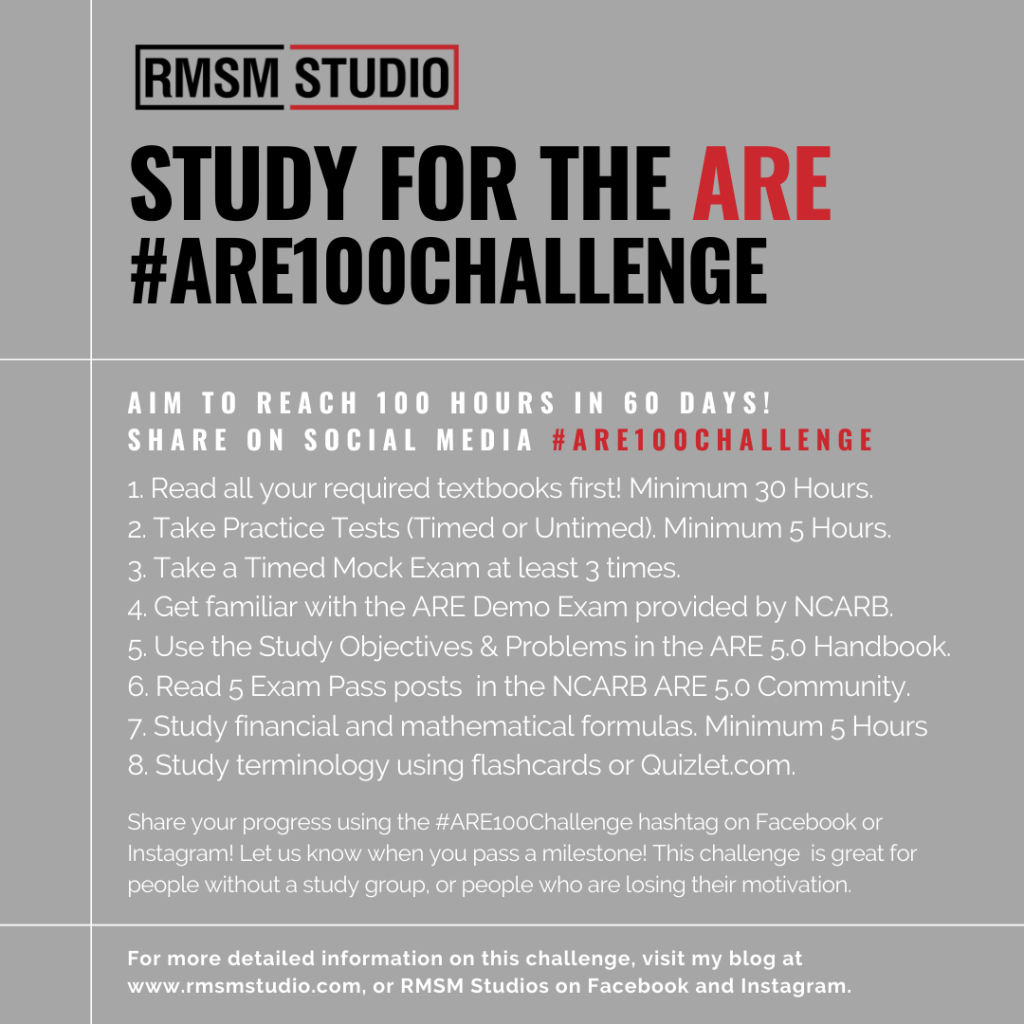
Need a fun way to stay motivated as you study for your exams? Join the #ARE100Challenge with other test takers to boost your study time and challenge yourself.

Some of the major challenges I’ve faced while studying for the ARE 5.0:

  1. Soooo much reading, from so many different types of resources, it’s hard to keep track of it all.
  2. No study group, and since everyone is taking a different test on a different day, it’s hard to create one with the people around you.
  3. It’s hard to stay motivated, and the materials seem like they’ll never end.
  4. It’s easy to get distracted by the minutia of the materials, and lose sight of the big picture.

To help myself and others experiencing these problems, I’ve created the #ARE100Challenge to bring together the ARE 5.0 test taking community, whether studying solo or with a group.

How to Participate

The main objective of the challenge is to complete 100 hours of studying in 60 days, regardless of which exam you’re taking.

For some this may seem like an easy target and will just provide an additional boost. However, for some test takers, this may be a serious challenge in terms of finding time to fit in studying. Wherever you are in your study plan, let’s challenge and push each other to make the most of the time we have!

The Ground Rules

1. Read all your required textbooks first! Minimum 30 Hours.

Check the NCARB Reference Matrix, NCARB ARE 5.0 Community, or the ARE Facebook Group for recommended study amterials for each test.

2. Take Practice Tests (Timed or Untimed). Minimum 5 Hours.

There are so many resources and content creators for practice tests and questions, again the forums are a great resource for recommendaitons on what will work best for the test you’re taking..

3. Take a Timed Mock Exam at least 3 times.

This can be one testing resource that you think works really well, or many different tests. The idea is that you take the completed, timed tests, review your answers, and identify the content you need to focus on.

4. Get familiar with the ARE Demo Exam provided by NCARB.

Even if you’ve taken the exam already, it is always a good idea to reaffirm the interface before you head back into your next exam. If you’ve never taken the exam, you should have an understanding of how answering all the question types work, as well as the tools available within the testing software. Did you know you can search documents?

5. Use the Study Objectives & Problems in the ARE 5.0 Handbook.

Make sure that you are covering topics within your study plan that align with the provided exam objectives within the NCARB ARE 5.0 Handbook for that specific test. Some practice tests can let you know which areas you’re weak on, so you should take the opportunity to review them.

6. Read 5 Exam Pass posts in the NCARB ARE 5.0 Community.

It’s always good to keep a positive mindset in these exams, which can have a large mental toll. A great way to do this is by reading the stories of other people who have passed the same exam recently. This has multiple benefits:

  1. You can see what study materials and methods other successful test takers used.
  2. It lets you know that other people are passing these tests, and that they’re not impossible.
  3. You can ask those people questions about specific problems you are having within that same exam, while it’s fresh in their minds.

7. Study financial and mathematical formulas. Minimum 5 Hours

The math and financial portions can be very challenging for people who may not have a lot of familiarity with it within their offices. Make sure to dedicate time to memorizing the concepts relevant to your exam, so when you step into the exam, you know exactly what the question is asking for.

8. Study terminology using flashcards or Quizlet.com.

The terminology needed to pass each exam section can vary widely, which is why some prefer to study using a separate flash card deck for each exam. Flash cards are also available as physical copies. I personally like to use Quizlet.com, as it allows me to check my familiarity with each card, turn the card decks into quizzes and games, and update definitions to make them clearer. A lot of people have used Quizlet in the past to study for these exams, so you can easily find premade decks that you can use for each exam section.

Track Your Progress!

I love using Clockify.com to keep track of my studying hours, mostly because of how simple their tracking and timekeeping system is.

Another great app for tracking your time while you study on the go is the Productivity Challenge Timer App, for another layer of gamification and fun. The free version is a bit limited, which is why I normally prefer to use Clockify to track everything.

Post Your Progress!

Share your progress using the #ARE100Challenge hashtag on Facebook or Instagram, and let us know when you pass a milestone! We’re all in this together, so let’s celebrate the wins, both big and small!

If you have any questions, feel free to reach out to me here on the blog, or on Facebook or Instagram. Happy studying and good luck on your #ARE100Challenge!

My Number One Rule for Buying ARE Study Materials

When you first decide to take the ARE, you will normally go into full research mode. You treat it like a site you are doing analysis on, combing the net for study materials, handy guides, YouTube tutorials and practice questions, exam focused blog posts (guilty!), everything you can get your hands on. You assemble a treasure trove of PDF documents and a wish list full of textbooks and online courses, and you start reading. Fast forward a few hours, and you are completely overwhelmed.

The ARE is full of SO MUCH CONTENT and the sheer amount of information that you need to not just absorb, but be able to use for problem solving, can be extremely intimidating. What can be even scarier, if you’ve been working for a while in the field, is the practice of unlearning what you thought you knew, and memorizing the way that NCARB wants you practice. This can make you second guess your own memory and possibly your own professional judgement.

I got to this same point after ordering my Ballast book. I love to read, like LOVE to read, but this seemed like taking a good thing too far. There’s a difference between sitting down with a nice thick book and reading for pleasure, and sitting down with a thick book and being expected to memorize and analyze its contents.

The study guides, contracts, online resources, and the other miscellaneous PDFs I had collected and bought as part of my search for information, were also confusing. With this much data, how is it possible to prioritize and process all that I read?

This lead me to my number one rule for ARE Study Materials:

AHPP (Architect’s Handbook of Professional Practice) First! No New Study Materials Until It’s Finished!

I created this rule for myself for a few important reasons:

  1. I have a habit of collecting a lot of data for the sake of saying that I have the information, then not reading it. This will save me a lot of wasted time in gathering studying materials that I will actually not use. 
  2. The AHPP is frequently considered required reading by those who take the exam. I’ve seen many people mention just this textbook, along with the contracts and rules of conduct, as their only required materials for passing the PcM (Practice Management Exam).
  3. You have help in determining what is essential! Namour Wright collaborated with Wiley publishing to create very helpful guides regarding which elements of the AHPP were critical reading for each specific ARE exam. 
  4. If I can’t commit to finishing this book, there is no reason for me to be flushing additional money or time down the drain looking at less comprehensive content. The AHPP is a big book, but the information it contains is crucial information for all 6 ARE exams. It is the only reference listed in the ARE 5.0 Handbook which has content used in the development of all 6 of the exams. Check out this references page from NCARB which illustrates my point. 
NCARB Reference Guide for AHPP

So even though it is important to cross train with other materials, use multiple references, and understand and read through other documents, I still put the completion of this document as my number one priority, and until you finish it, I wouldn’t put another cent into buying anything else. You can buy the AHPP on Amazon, or directly from Wiley Publishing. 

There are also pre-owned copies online, and often you can already find a copy at your architecture firm, as people who have studied in your firm like to keep it around as a reference in their practice.

What text would you consider an essential item for this exam? Let me know in the comments! Happy studying!