Understanding the process for Substantial Completion based on the AIA A201
So I recently passed my CE exam, and as part of my studying for it, I actually created a list of what has to take place in Substantial Completion. This list was based off of reading the A201 – General Conditions of Contract, and really trying to understand the progression of each action.
A good document to help you understand this concept further is the G704 – Certificate of Substantial Completion itself. Here’s a video from the AIA on how to fill one out:
So after I created my list, I thought, “This would be really great to have in the form of an infographic.”, so I decided to share this with you all. I highly recommend that you read the A201 yourself, try out some practice questions for it, and listen to the lectures for it as well for a deeper understanding. Lectures on the A201 General Conditions of Contract are provided from Michael Hanahan, Young Architect Academy Contracts Course, and Pluralsight Project Management Course, so it’s really up to you which platform works best.
Did you find the graphic helpful, or do you remember the difference between substantial completion and final completion in a different way? Let me know in the comments!
Rules that I use to keep focused as I study for the ARE 5.0
I spend a lot of time studying for my exams, so you might be wondering how I stay focused and study effectively. Together with my accountability partner, I was able to come up with some concrete rules on ways to study effectively without wearing myself out. You don’t have to follow these rules yourself, but feel free to use them as a template if you think they’ll help your study process.
1. Phone in a Different Room
This was a major one, as my phone is a major distraction for me. It’s the easiest way for me to get derailed in my study sessions. So the method that I use is to leave it to charge in a completely different room on silent. It’s a simple method, but it really works.
Another method that I’ve started using recently for productivity tracking and distraction free testing is using the Flora app. This app has a variety of great uses including time tracking and locked in study time frames, that stop you from seeing your phone notifications and checking your feeds, as you will lose all your studying progress. It also allows you to set time goals for yourself, and track your total hours over time. Flora also has a very fun function that allows you collect plants, trees and flowers for each successful study session, so you can create a new garden every week.
2. Laptop: Only Music & Clockify
Even though I avoid using my phone, I still need to use my laptop for activities like Young Architect or Pluralsight videos, Hyperfine assignments, or looking up concepts I’m studying, so I still keep it with me when I’m studying.
However, when I’m not studying with it directly, how do I make sure I don’t get distracted? I make sure that I’m only using my laptop for my studytime playlist on Youtube, and for the Clockify app for my time tracking. I’ve talked about how I use Clockify for both my PcM and PjM passes.
3. One Architecture & Design Event Per Week
In one of my posts, I’ve described in detail why I’m trying to avoid architecture events. They are a big temptation for me because I love to learn, but they also take up time that I could be studying. So I’m only allowing myself to attend one architecture event per week, and that includes events hosted in-house at my company. It doesn’t matter whether it virtual (they’re all virtual at this point, lol) or in person.
Since I’m still wrapping up the last few hours of my AXP, I definitely value being able to use architecture events to earn AIA LUs (Learning Units) and CEUs. However, I feel like the AXP Hours will come eventually, but passing these exams may not happen without my deliberate effort.
4. One Personal Event Per Week
With a similar reasoning as for the architecture events, I’m trying to limit my interpersonal events and meetings. My state is currently in Phase III of reopening, so things are more relaxed and there are way more opportunities to interact than just a few months ago.
However, I realize that these social events take several hours out of my day, between the transport and the actual meeting. So until I pass these exams, I’m limiting myself to just one social/personal event or gathering a week.
5. Only 1 hour MAX of studying on site visit days or traveling days
We all know that work can get intense, which is why a lot of people recommend that you only start studying for the AREs if you have the time available. As I’m about to mention below, if you don’t have 3 hours a day free to study, you’re really going to struggle with this exam.
But sometimes we have those workdays that drain you and leave you completely able to function once you get home. That’s ok! Give yourself permission to take it easy, if you need a break. Your body and mind will thank you. Build this into your schedule, so if necessary, you can study for additional hours on the days you know you don’t have site visits or late nights. On days like that, I give myself permission to study for one hour or zero hours.
6. Study for 3 hours a day
So this is my goal for each studying day. I don’t always reach it, but it’s what I aim towards. One thing about my studying method is that I plan what I’m going to study weeks in advance, and sometimes it takes less than 3 hours. That’s still fine! I get that time back in my day if I’ve thoroughly studied everything on my plate for that day.
Normally I track my daily hourly totals through Clockify or through the Flora app on my phone. Clockify also allows you to see your overall study totals, and seeing that number go up is a big motivator for me. I have a goal to study 100 hours per exam, which I tried to capture in the #ARE100Challenge, which encourages people to study 100 hours for the ARE Exam. I also use the Study Material Tracker I created to help me figure out my overall hourly goal for each study resource.
7. One detail or document a day
This one is straightforward and is very helpful if you are taking any technical exams or CE, which I recently passed! It basically means that you are checking out or drawing or sketching a new detail or document every day.
You guys have gotten this far, so I’m pretty sure you know how to sketch. For the documents portion, it just involves going one step beyond your study materials. Cross train with real-world examples of your study content.
For example, if you were studying concrete and slump tests, watch a video of a slump test being conducted, or check out an actual test report. It really helps you with filling in the gaps of your experience and helps you better visualize the concepts.
8. No studying after midnight
This is as simple as it is effective. I know in the architectural studio we prided ourselves on our long hours and thought that showed a level of dedication to our craft.
However, there are a lot of negative effects of studying late into the night, the most important of which for me is that I’m completely burned out by the next day, and I use my late night to justify studying less the next day.
Don’t fall for this cycle, it is a trap! Get the study hours you need in enough time to get to bed at a reasonable time (now I sound like someone’s mom), and your body and mind will thank you. I want my mind to be in top form for both my work and for studying again the next day.
9. All Notes need Title & Date
Do you take notes when you study? A lot of people do. I was against it at first, because it just felt like repetition to me, but I’ve been convinced of its usefulness over time.
But if you have a binder full of notes, on different subjects without labels, you’ll have no idea what you’ve studied, the relevant objectives, and whether or not you’ve covered this material before. So I try to make sure that every page is labeled with the title of the study material, the subject matter, and the date. This keeps my notes organized and lets me see my level of understanding of the content over time since I write my notes in my own words.
Another useful note-taking tip for me is that I don’t write what I already know. Really basic information that I already know and will be able to remember for the exam, I don’t bother to write down. For example, what is the B101? I don’t need to write that down, I know that easily. As you start to absorb information, you’ll have to write less and less in your notes, making it easier to review materials.
If you made it to the end of this lengthy post, congrats! Thank you for taking the time to read it all, and I hope this explanation of my study time rules gave you some inspiration on things to add to your own routine.
If you’d like to support my page and get updates on all of my new content, follow me on Facebook and Instagram.
My challenges with the Construction & Evaluation Exam.
I got the official score report from NCARB last night, so excited to share that I passed CE this Tuesday! I was really nervous about this exam, since it had been my only fail so far, and I did NOT want to pay that $235 again. My major challenges for this test were:
A definite lack of clarity from NCARB’s side on the inclusion of the construction & detail sections of this exam, for examples, details, sections, etc, that they showed in the Handbook practice questions, but not in their reference lists.
Struggling to read these contracts all over again. When I feel like I know something already, my brain starts to shut it out, because it feels like I already know this information. But rereading and rewriting the contracts was definitely helpful for me.
A lack of practice questions that dealt with those construction sections that I mentioned above, but I’ll be sharing some resources I found in my normal detailed blog post that I do after every passed exam.
Figuring out what was or was not important in terms of contracts. Do I need to memorize all the contract times and time limits, or is that going too deep? I know there’s no such thing as over-studying for this exam, but I felt like sometimes I was focusing on the wrong things. At some point my study group found a video on deciphering welding symbols, and we were like, you never know, this might come up!
Worrying about any distractions and the effect it will have on my exam result. I decided to pursue my LEED Green Associate credential (which I got) as an additional certification that I can use for work. I’m already a Green Star accredited professional in Namibia and South Africa, but I felt like I needed the certification in the U.S. as well. But I was really worried that the two weeks I took off to study for the LEED Green Associate exams would make or break me for CE.
Do I need more experience in residential construction? A lot of the projects that I’ve worked on have been institutional, educational, healthcare, and I’ve never worked on a building that used wood structure before. I was worried that the lack of experience in this specific area would hurt me in the exam, but my study group made sure to look at examples of actual construction sets, so i was at least familiar with how things would actually look, and of course, there are the textbooks that cover those things as well.
What will my timeline be like if I fail? I’m currently trying to take and pass all of my exams before NCARB transitions into the new testing provider PSI. If I failed CE, would I have to further delay taking my PPD and PDD? Luckily it didn’t come to that, but it was a genuine worry that I had.
Do you know this famous quote from Muhammad Ali?
This is me right now. I hate studying so much! I feel like I watched summer pass me by through the window by my desk. This test takes so much out of you in terms of time and mental load, and it bothers me that I feel like I can’t be fully present for my family and friends. But I think that the end result is definitely worth it.
Overall, I would say that I’m super happy and relieved that I have this exam under my belt, and ecstatic that I am halfway through this process. I am trying to make sure that this time I intentionally celebrate my win, and properly rest before I dive into PA. Stay tuned for my detailed blog post, and I wish you guys all the best in your ARE journey’s as well. If you have any specific questions about CE, make sure to ask me in the comments, and I may be able to address them in my upcoming blog post.
Explaining the differences between the statute of repose and statute of limitations, with a free wallpaper download!
*This post has been corrected based off of helpful information from the ARE Facebook group.*
So in my ARE study group we were discussing the differences between these two concepts, and how confusing the many different references can be when trying to explain them. You can read several resources and watch many videos explaining the concept of statute of repose and statute of limitations, and that’s all fine and dandy, but what the actual limits when it comes to construction?
Here are some of the videos I checked out for reference:
Another helpful video by an actual architect, Werner Sabo:
These videos were helpful, but they didn’t give me the answer I was looking for. I thought it would be best to check the Architects Handbook, as it is definitely one of the main resources that NCARB is using to create these exams. *However, it does appear that the AHPP is wrong on this one.
What I found was, at its most basic level:
Statute of Repose is a claim based on negligence for design professionals or others, 3 to 10 years after substantial completion.
Statute of Limitations sets time limits under which claims can be made, commencing when the alleged digression is discovered, normally 10 years.
That’s it, that’s the difference. Each state has its own time limits, I had fun checking out mine, which seem pretty average (this list taught me to never sign a contract in Maine, lol.) There are also reasons why on average, statutes of repose are longer than statutes of limitations. To quote this article from Kevin Hara, referencing the Texas Supreme Court,
The whole point of layering a statute of repose over the statute of limitations is to fix an outer limit beyond which no action can be maintained. One practical upside of curbing open-ended exposure is to prevent defendants from answering claims where evidence may prove elusive due to unavailable witnesses (perhaps deceased), faded memories, lost or destroyed records, and institutions that no longer exist.
Methodist Healthcare Sys. of San Antonio v. Rankin, 307 S.W.3d 283, 286-87 (Tex. 2010 ) (internal citations and marks omitted)
To help me remember the difference between the two, I created a helpful wallpaper providing the differences in a simple way. You can get it for free at my Downloads page.
Learn what study materials and methods I used to pass ARE 5.0 PjM exam from NCARB on my first try.
I’m very excited to share that I passed my PjM exam a few weeks ago. I am releasing it late due to a hectic project, however, I still know exactly what I studied and for how long due to my continued use of Clockify, (which I go more in depth with below).
I worked full time (and then some), met up with my study group to study for this exam once a week, and listened to audio/video lectures while working, and got most of my studying done at night. Separate from my study group, I also had an accountability partner at work through our Iron Buddy program. I aimed to study at least three hours a day except for days when I had site visits, when I studied for one hour or less.
My major motivator in looking for study materials was to continue being very cost effective. I wanted to continue taking advantage of the resources I had used for PcM, while making sure that I didn’t have any knowledge gaps. I’m really trying to make sure I invest the money necessary up front, because no textbook I buy will be as expensive as retaking these exams lol.
I would like to send a big shout out to my study group, who were instrumental in supporting me and keeping me focused. I highly recommend you join one specific to your exam, so you can all learn and grow together.
Books
The Architects Handbook of Professional Practice (AHPP) – a critical resource which was very helpful for my PcM pass. The would say that this document is an essential reference for the 3 ARE 5 Practice exams. There are AHPP reading guides provided by Wiley publishing and Pluralsight were very helpful. It goes over the roles and responsibilities very well for project management. This is a very thick book, and to be honest it is required reading, you really shouldn’t skip it. It’s like eating your vegetables. I was able to get a copy of the AHPP for free from my office, so check if your office has a copy.
Price: AHPP – Free for me.
ARE 5 Review Manual (Ballast) – Ballast’s Project management section is very detailed and illustrative. I don’t have a specific reading guide to recommend, but you should definitely check out the specific Project management Chapters. Some people use this as a standalone reference for the PjM exam, but I would definitely recommend that you cross train with other materials.
Price: Ballast Review Manual – $190
Contracts
NCARB covers a lot of contracts for the PjM exam as you can see below.
My method for the contracts was:
Reading through the all actual contracts above at least once
Rewriting the contracts in shorthand as described in Christopher Richardson’s NCARB forum post
The Young Architect Contracts course was an essential reference for me. One of the biggest advantages of the Young Architects course over similar audio such as Schiff Hardin is that it goes through all of the contracts that are listed in the NCARB matrix, not just the B101 and A201. Since so much of this exam is based on the contracts, they don’t actually let you purchase the Young Architects Project Management course without the Contracts course.
Price:
Contracts: free on AIA website
Contract shorthand: free
Study Guide: free
Young Architects Contracts Course individually ($85)
Digital Resources
Quizlet – Full disclosure, I am not a big fan of physical flashcard decks. They’re a hassle to write and organize. I greatly prefer using digital flash cards for easy portability, I can save my spot in learning and test myself all within one app. One functionality that I recently started enjoying, since I joined a study group, is the ability to host live games using Quizlet to compete with other group members.
AIA Contracts Deck – Also very critical for ensuring you KNOW the contract numbers, and you’re not just guessing.
AIA Contracts Diagram Deck – This deck comes with pictures that allow you to define the contract parties relationships.
Price for all decks: Free
NCARB Forum – Whenever I have a new exam scheduled, the NCARB Forum is the first place I go to learn how other people have passed the exam. Here are some of the helpful posts that I found for the PjM exam.
Young Architect Project Management Course – this was a crucial resource for me. The great thing about this course is that it breaks everything down by the specific exam objectives. The Young Architect courses are a great value in that they are a one-time payment, after which you always have access to the course instead of a one-time. Out of all the guided programs for this exam, this one had some of the highest reviews and was the most cost-effective.
Price: It must be purchased along with the Contracts course. For both courses together it is $169.
Schiff Hardin Lectures – These are a great resource, especially for people who can’t afford to get the Pluralsight or Young Architect Contract courses to explain the A201 and B101 contracts, which are key contracts for this exam. These audio lectures are great to listen to during work or during long commutes, and they come with PDF slides so you can follow along.
Price for Audio Lectures: Free
Practice Exams
Designer Hacks PjM Exam – My office allows us to purchase one textbook for our professional exams. So I asked them to purchase the full Designer Hacks practice questions for all 6 exams, since they were the same price as one physical textbook. Designer Hacks is super portable, with its mobile version, along with multiple levels from pop quizzes to full length timed exams. You can find my one-minute review for this resource here.
Price: This item was free for me as described above, but for this course alone it is $39.
Ballast Practice Exam – These practice problems were at a level of difficulty on par with the actual exams. This practice exam book includes all 6 ARE divisions, so you’ll only have to buy the book once for all of your exams. They are split up into the different exam sections, and allow you to answer them as one long practice exam, or break it down into the separate exam sections.
Time Tracking Software
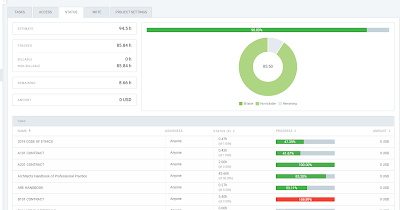
Clockify Website – I now use this website for all of my exams, to keep track of the materials I’ve studied and time spent for each resource. I can even check my progress on a daily basis, and see how many hours I study per day. This can be even better if you have specific study goals for each resource. You can use my study material tracker to list your hourly study goals for each.
Price: Free
Resources I Did Not Use
Black Spectacles – Not a lot of positive reviews and extremely expensive. I wish they broke their program into individual parts as it would be useful to try their demo exam independent of their other offerings.
Pluralsight – since Pluralsight’s PjM course is mostly contracts, I didn’t want to purchase both this and the YA Contracts course.
Brightwood – The reviews for these materials weren’t very positive, and I felt like I have enough textbooks between AHPP and Ballast.
AEP – expensive, and not enough positive reviews to purchase
Amberbooks – I didn’t get Amberbooks for this exam, but I may use it if I don’t pass my upcoming CE exam.
Young Architect Bootcamp – If I am thinking of possibly investing in this for the final 3 technical exams, if I pass Construction Administration.
In Conclusion, I’m super glad I passed this exam on the first try, and I hope you get some good out of my methods or recommended materials. If you have any questions, feel free to message me in the chat. Wanna study along with me? I’ve created a #studywithme video so you can join me for a 2 hour Pomodoro session, and not have to study alone.
ARE Master Material List
The Master Material List was a list and resource I put together to provide a comprehensive, one-stop solution for those trying to buy and understand ARE study materials. The list shows the material formats, the exams each one was used for, rental options, and prices. I have also included free materials I used within this list. You can get your copy here for free, and read along with the video replay of the live session.
So excited to announce that I passed my project management exam just last week. This is another great step forward in my ARE journey, and thank you for following me this far. I’m still getting over my post-exam jitters. I will be sharing my detailed study list and study methods in a few days. Keep your eyes peeled for my detailed study materials blog post, try out some of my PjM practice questions, and happy studying!
After my recent ARE exam fail, I had a solid pity party for a few hours, then decided it would be more productive to write down what I have learned from my first failure.
Never Assume You Have Time Just Because You’re Moving Quickly
In the first half of the exam I was moving fast and doing good, I completed all of my multiple choice exams, and hit pause before going off to my break. I thought I had plenty of time. Fast forward to the end of the exam, with seconds left and still a few unanswered case study questions which I eventually just had to guess at. Time management is KEY to this exam. Don’t make my mistakes, make sure that getting through the test as a whole is your main priority and never think that you have it under control just because you made it through the multiple choice questions quickly.
Don’t Cram What You Don’t Know
Again, in studying for the exams, it is the same as taking the exams, time management is KEY. In the days before your exams, you’re going to be dealing with a lot of emotions and anxiety, don’t make this worse by trying to cram in a bunch of material you have never even looked at before. It will make you feel worse because:
You’ll feel like you don’t know anything, even if you’re really strong on other topics
You will get frustrated at your inability to retain this brand new information
You’re dealing with exam nerves, and if you do badly on practice tests on the new material, your confidence will be shot
Make sure, well before you’re scheduled to take your exams, you’re making sure that all the topics that are going to be included in the test are a part of your study plan. Be intentional about what you’re reading, not just trying to read as much as possible. This guide on test-taking skills has a lot of helpful tips on getting prepared in advance.
Reinforce Your Weaknesses
While I wouldn’t recommend cramming new material right before an exam, I would recommend checking the information that you know that you are not performing well on. There’s a difference between trying to learn all the details of ADA clearances in one day, and having a look at your previous notes on contract documents. One involves completely learning new concepts, the other is just brushing up on what you already know.
I would say working on your weaknesses is especially important AFTER you’ve failed the exam as well. The study materials that got you a poor result may not give you success the next time around, so make sure that you are making changes to your methods or resources based off of what your previous exam was asking you. This is part of the reason why the ARE’s are called “the most expensive practice exam you’ll ever take”. Failing is part of the process, and learning from the fails is part of the process too.
One thing I’ve done is to look at multiple posts of people who have passed each specific exam, and tried to change my method based on the different content that they used. You can find passing stories on the ARE Facebook group or in the NCARB ARE 5.0 Community.
Don’t be afraid to write your own questions
In my recent exam failure, I was very frustrated with some of the practice question providers, since I felt like they failed to cover some of the very technical and graphic aspects of that exam. I was also mad at NCARB for failing to properly specify the resources that were needed to pass that exam. However, being mad at external forces won’t bring me any closer to passing the ARE.
So my recommendation is, if you feel like the questions you’re seeing on the exam are not matching the materials you are studying, feel free to write your own questions. There is literally nothing stopping you, as long as you are not copying the questions that you’ve seen in your previous ARE exams. These questions can be at whatever level of difficulty you feel comfortable with, but I have the following tips:
Use the source material. If you’re writing a question on contracts, use the actual contract to write the question based on what you’ve literally read in the contract, not what Ballast, Pluralsight or Hyperfine wrote about it. This is because a lot of study resources summarize instead of writing the actual articles, which may cause you to remember the phrasing or intent clearly later on.
Write why the answers are correct and why they’re wrong. This will force you to explain exactly why you’ve chosen that answer, and helps cement the concept, not just the specific answer.
Share your questions! Not only does this help other people who are studying, but this also allows them to let you know if your answers are wrong and why. If people have further questions. You can share in your personal study group, which you can join through the NCARB ARE Community, in the ARE Facebook group, or with your architecture mentor, and see if they can work through the correct answer based on their professional experience.
Mini Quiz from RMSM Studio on Construction Manager Project Delivery Methods
I haven’t had any experience in the past with working with Construction Managers, so I feel like I really had to go the extra mile to understand all the differences and roles & responsibilities in the different CM project delivery methods. I’ve created some very handy charts to help explain the differences between CMa and CMc, I may release it later when I’m less overwhelmed.
I’m also trying to get back into the habit of regular note taking instead of being so focused on watching the explanatory videos. I was really inspired by this video I watched today by Jorge Herrera on quick study tips. I’ll probably be buying an assortment of notebooks and binders for my path forward, and take advantage of some of these back to school sales.
Question 01
Joanne Bowman is the manager of a government branch looking to expand in the near future. She is looking for a high-quality design, with low risk. Which project delivery methods would you, as her architect, recommend to her? (Select two)
Design-Bid-Build
Construction Manager as Advisor
Construction Manager as Constructor
Integrated Project Delivery
Question 02
While on the construction site, the Project Architect Maryam Lanoir notices a defect in the work. Since this project is a Construction Manager as Advisor project delivery method, what should be her next steps?
Instruct the superintendent to correct the deficiency, as per the contract drawings
Notify the Owner
Notify the Contractor
Notify the Construction manager
All of the above
Question 03
Jessica Trevi is an architect providing construction administration services on a Construction Manager as Advisor project. What is not a joint service that she provides?
Certifying applications for payment
Preparing change orders
Reviewing RFIs
Rejecting work
Question 01
CORRECT ANSWERS
Construction Manager as Constructor
Integrated Project Delivery
Both CMc and IPD are preferred in projects with high building quality standards, and where owners want to reduce their risk.
inCORRECT ANSWERS
Construction Manager as Adviser is a preferred choice for reducing project risk, but it is not always used for high building quality. Design-bid-build, is known for being low cost, which also can create low quality, as well as being high risk.
For reference, read Ballast Chapter 3.
Question 02
While on the construction site, the Project Architect Maryam Lanoir notices a defect in the work. Since this project is a Construction Manager as Advisor project delivery method, what should be her next steps?
Notify the Owner
Notify the Contractor
Notify the Construction Manager
With CMa projects, it is the architect’s responsibility to notify the Owner and the Construction Manager of any observed defects and deficiencies. See A232 – Article 4.2.2
The architect is not able to issue instructions to the superintendent. According to A232 – Article 3.9.1, it is only communications, not instructions that can be given to the superintendent.
Question 03
Jessica Trevi is an architect providing construction administration services on a Construction Manager as Advisor project. What is not a joint service that she provides?
Preparing change orders
CORRECT ANSWER
Preparing change orders or construction change directives is not a joint service provided the architect in construction administration.
Certifying applications for payment, RFI review and rejecting work is something that is done by both the CM and architect in a CMa project delivery.
I hope you like this mini quiz. Let me know how you did in the comments, or on the RMSM Studio Facebook page.
All of my recent practice questions are now available in one place, on the Practice Questions page in the top menu.
Mini Quiz from RMSM Studio on the Management of Risk For Architects
Risk Management is one of the key concepts in all stages of design. This is because whenever you are creating a building, you must always assume some risk. This is an essential concept for both Practice Management and Project Management. In the Wiley AHPP Guide for the Project Management (PjM) Exam, under the Risk Management chapter, they just say “All”. It’s that important. I hope you enjoy this mini quiz and as always, let me know how you did in the comments.
Question 01
Which types of firms will some underwriters have hesitation insuring?
Those with low deductibles
Those that don’t provide construction administration services
Those with a high number of inexperienced employees
Those using the AIA contract document suite
Question 02
Jay York, Esq. is an attorney who has been hired by Jasmine Board Architects. They have been hired to review their proposed insurance policies. Which of the following policy’s should Jay mark for further review with Jasmine Board Architects?
Indemnification for those not party to the Agreement
Client indemnity to architect for misuse of the architect’s drawings
Defending the Owner against third-party claims
Mutual indemnities between architects and consultants
All of the above
Question 03
Select all problematic words from the advertisement below created by Diedre Lock Associates:
Question 01
Those that don’t provide construction administration services
There is a high number of claims that arise when an architect only provides pre-construction services, as they are not there to defend themselves or their drawings.
Incorrect Answers
Those with low deductibles – Deductibles with another insurer would not affect another company’s coverage.
Those with a high number of inexperienced employees – As long as there are staff available that are qualified to complete the projects on hand, the number of inexperienced employees is irrelevant.
Those using the AIA contract document suite – Using a the standard AIA contract documents means that an insurer specializing in construction would be more likely to insure you, due to the industry’s familiarity with them.
Question 02
Policies that should be reviewed, due to being unmanageable risks, are:
Indemnification for those not party to the Agreement
Client indemnity to architect for misuse of the architect’s drawings
Defending the Owner against third-party claims
Incorrect Answers
Mutual indemnities between architects and consultants is actually a beneficial policy for an architect’s agreement. Study B101 8.4 for a good model of policies.
Question 03
The problematic words in this advertisement were:
Ensure
Best
100% Completion
All
Assured
Thorough
Best
Guaranteed
I hope you like this mini quiz. Let me know how you did in the comments, or on the RMSM Studio Facebook page.
If you’re studying for Practice Management, feel free to check out my other Mini Quiz on the AIA A201 Document and my post on passing the PcM Exam. I have also created a one-page study guide based on the methods I used to pass PcM on the first try.
If you’re studying for Construction & Evaluation or Project Management, check out my Mini Quiz on the AIA C401 Contract.
All of my recent practice questions are also available for you to scroll through below, or on the specific page I’ve created for them at the top of the website:
As I continue to study for ARE 5.0 Project Management, one of the areas I struggle with the most is Quality Management, but not for the reason you might think. For me, a lot of the concepts seem so obvious that it’s difficult for me to retain. So I’ll be reading it, agreeing with everything it says, but not retaining any specifics. So I’ve been trying to work on that in ways that will stay in my memory. Videos like the one below, and other tools are great visual aids to help me retain those details.
Practice Problem: Quality Management
Which of these items are not elements of a Quality Management (QM) in Construction Procurement?
Effective In-House Procurement Protocol
Beneficial Support Resources
Constant Monitoring and Documentation
Document Access and Control
Correct Answer
Document Access and Control is an Element of Quality Management in Construction Administration.
Wrong Answers
All of these items are Elements of Quality Management in Construction Procurement:
Effective In-House Procurement Protocol
Beneficial Support Resources
Constant Monitoring and Documentation
For reference for this question, check out AHPP Chapter 12.4.
Let me know how you did on this question, and make sure to follow RMSM Studios on Facebook and Instagram!





 RMSM Studio