My Studytime Rules

Rules that I use to keep focused as I study for the ARE 5.0

I spend a lot of time studying for my exams, so you might be wondering how I stay focused and study effectively. Together with my accountability partner, I was able to come up with some concrete rules on ways to study effectively without wearing myself out. You don’t have to follow these rules yourself, but feel free to use them as a template if you think they’ll help your study process.

1. Phone in a Different Room

This was a major one, as my phone is a major distraction for me. It’s the easiest way for me to get derailed in my study sessions. So the method that I use is to leave it to charge in a completely different room on silent. It’s a simple method, but it really works.

Another method that I’ve started using recently for productivity tracking and distraction free testing is using the Flora app. This app has a variety of great uses including time tracking and locked in study time frames, that stop you from seeing your phone notifications and checking your feeds, as you will lose all your studying progress. It also allows you to set time goals for yourself, and track your total hours over time. Flora also has a very fun function that allows you collect plants, trees and flowers for each successful study session, so you can create a new garden every week.

2. Laptop: Only Music & Clockify

Even though I avoid using my phone, I still need to use my laptop for activities like Young Architect or Pluralsight videos, Hyperfine assignments, or looking up concepts I’m studying, so I still keep it with me when I’m studying.

However, when I’m not studying with it directly, how do I make sure I don’t get distracted? I make sure that I’m only using my laptop for my studytime playlist on Youtube, and for the Clockify app for my time tracking. I’ve talked about how I use Clockify for both my PcM and PjM passes.

3. One Architecture & Design Event Per Week

In one of my posts, I’ve described in detail why I’m trying to avoid architecture events. They are a big temptation for me because I love to learn, but they also take up time that I could be studying. So I’m only allowing myself to attend one architecture event per week, and that includes events hosted in-house at my company. It doesn’t matter whether it virtual (they’re all virtual at this point, lol) or in person.

Since I’m still wrapping up the last few hours of my AXP, I definitely value being able to use architecture events to earn AIA LUs (Learning Units) and CEUs. However, I feel like the AXP Hours will come eventually, but passing these exams may not happen without my deliberate effort.

4. One Personal Event Per Week

With a similar reasoning as for the architecture events, I’m trying to limit my interpersonal events and meetings. My state is currently in Phase III of reopening, so things are more relaxed and there are way more opportunities to interact than just a few months ago.

However, I realize that these social events take several hours out of my day, between the transport and the actual meeting. So until I pass these exams, I’m limiting myself to just one social/personal event or gathering a week.

5. Only 1 hour MAX of studying on site visit days or traveling days

We all know that work can get intense, which is why a lot of people recommend that you only start studying for the AREs if you have the time available. As I’m about to mention below, if you don’t have 3 hours a day free to study, you’re really going to struggle with this exam.

But sometimes we have those workdays that drain you and leave you completely able to function once you get home. That’s ok! Give yourself permission to take it easy, if you need a break. Your body and mind will thank you. Build this into your schedule, so if necessary, you can study for additional hours on the days you know you don’t have site visits or late nights. On days like that, I give myself permission to study for one hour or zero hours.

6. Study for 3 hours a day

So this is my goal for each studying day. I don’t always reach it, but it’s what I aim towards. One thing about my studying method is that I plan what I’m going to study weeks in advance, and sometimes it takes less than 3 hours. That’s still fine! I get that time back in my day if I’ve thoroughly studied everything on my plate for that day.

Normally I track my daily hourly totals through Clockify or through the Flora app on my phone. Clockify also allows you to see your overall study totals, and seeing that number go up is a big motivator for me. I have a goal to study 100 hours per exam, which I tried to capture in the #ARE100Challenge, which encourages people to study 100 hours for the ARE Exam. I also use the Study Material Tracker I created to help me figure out my overall hourly goal for each study resource.

7. One detail or document a day

This one is straightforward and is very helpful if you are taking any technical exams or CE, which I recently passed! It basically means that you are checking out or drawing or sketching a new detail or document every day.

You guys have gotten this far, so I’m pretty sure you know how to sketch. For the documents portion, it just involves going one step beyond your study materials. Cross train with real-world examples of your study content.

For example, if you were studying concrete and slump tests, watch a video of a slump test being conducted, or check out an actual test report. It really helps you with filling in the gaps of your experience and helps you better visualize the concepts.

8. No studying after midnight

This is as simple as it is effective. I know in the architectural studio we prided ourselves on our long hours and thought that showed a level of dedication to our craft.

However, there are a lot of negative effects of studying late into the night, the most important of which for me is that I’m completely burned out by the next day, and I use my late night to justify studying less the next day.

Don’t fall for this cycle, it is a trap! Get the study hours you need in enough time to get to bed at a reasonable time (now I sound like someone’s mom), and your body and mind will thank you. I want my mind to be in top form for both my work and for studying again the next day.

9. All Notes need Title & Date

Do you take notes when you study? A lot of people do. I was against it at first, because it just felt like repetition to me, but I’ve been convinced of its usefulness over time.

But if you have a binder full of notes, on different subjects without labels, you’ll have no idea what you’ve studied, the relevant objectives, and whether or not you’ve covered this material before. So I try to make sure that every page is labeled with the title of the study material, the subject matter, and the date. This keeps my notes organized and lets me see my level of understanding of the content over time since I write my notes in my own words.

Another useful note-taking tip for me is that I don’t write what I already know. Really basic information that I already know and will be able to remember for the exam, I don’t bother to write down. For example, what is the B101? I don’t need to write that down, I know that easily. As you start to absorb information, you’ll have to write less and less in your notes, making it easier to review materials.


If you made it to the end of this lengthy post, congrats! Thank you for taking the time to read it all, and I hope this explanation of my study time rules gave you some inspiration on things to add to your own routine.

If you’d like to support my page and get updates on all of my new content, follow me on Facebook and Instagram.

I Passed Construction and Evaluation!

My challenges with the Construction & Evaluation Exam.

I got the official score report from NCARB last night, so excited to share that I passed CE this Tuesday! I was really nervous about this exam, since it had been my only fail so far, and I did NOT want to pay that $235 again. My major challenges for this test were:

  • A definite lack of clarity from NCARB’s side on the inclusion of the construction & detail sections of this exam, for examples, details, sections, etc, that they showed in the Handbook practice questions, but not in their reference lists.
  • Struggling to read these contracts all over again. When I feel like I know something already, my brain starts to shut it out, because it feels like I already know this information. But rereading and rewriting the contracts was definitely helpful for me.
  • A lack of practice questions that dealt with those construction sections that I mentioned above, but I’ll be sharing some resources I found in my normal detailed blog post that I do after every passed exam.
  • Figuring out what was or was not important in terms of contracts. Do I need to memorize all the contract times and time limits, or is that going too deep? I know there’s no such thing as over-studying for this exam, but I felt like sometimes I was focusing on the wrong things. At some point my study group found a video on deciphering welding symbols, and we were like, you never know, this might come up!
  • Worrying about any distractions and the effect it will have on my exam result. I decided to pursue my LEED Green Associate credential (which I got) as an additional certification that I can use for work. I’m already a Green Star accredited professional in Namibia and South Africa, but I felt like I needed the certification in the U.S. as well. But I was really worried that the two weeks I took off to study for the LEED Green Associate exams would make or break me for CE.
  • Do I need more experience in residential construction? A lot of the projects that I’ve worked on have been institutional, educational, healthcare, and I’ve never worked on a building that used wood structure before. I was worried that the lack of experience in this specific area would hurt me in the exam, but my study group made sure to look at examples of actual construction sets, so i was at least familiar with how things would actually look, and of course, there are the textbooks that cover those things as well.
  • What will my timeline be like if I fail? I’m currently trying to take and pass all of my exams before NCARB transitions into the new testing provider PSI. If I failed CE, would I have to further delay taking my PPD and PDD? Luckily it didn’t come to that, but it was a genuine worry that I had.
  • Do you know this famous quote from Muhammad Ali?

This is me right now. I hate studying so much! I feel like I watched summer pass me by through the window by my desk. This test takes so much out of you in terms of time and mental load, and it bothers me that I feel like I can’t be fully present for my family and friends. But I think that the end result is definitely worth it.

Overall, I would say that I’m super happy and relieved that I have this exam under my belt, and ecstatic that I am halfway through this process. I am trying to make sure that this time I intentionally celebrate my win, and properly rest before I dive into PA. Stay tuned for my detailed blog post, and I wish you guys all the best in your ARE journey’s as well. If you have any specific questions about CE, make sure to ask me in the comments, and I may be able to address them in my upcoming blog post.

PjM Pass ARE 5.0 – Study Materials and Methods

Learn what study materials and methods I used to pass ARE 5.0 PjM exam from NCARB on my first try.


I’m very excited to share that I passed my PjM exam a few weeks ago. I am releasing it late due to a hectic project, however, I still know exactly what I studied and for how long due to my continued use of Clockify, (which I go more in depth with below).

I worked full time (and then some), met up with my study group to study for this exam once a week, and listened to audio/video lectures while working, and got most of my studying done at night. Separate from my study group, I also had an accountability partner at work through our Iron Buddy program. I aimed to study at least three hours a day except for days when I had site visits, when I studied for one hour or less.

My major motivator in looking for study materials was to continue being very cost effective. I wanted to continue taking advantage of the resources I had used for PcM, while making sure that I didn’t have any knowledge gaps. I’m really trying to make sure I invest the money necessary up front, because no textbook I buy will be as expensive as retaking these exams lol.

I would like to send a big shout out to my study group, who were instrumental in supporting me and keeping me focused. I highly recommend you join one specific to your exam, so you can all learn and grow together.

Books

The Architects Handbook of Professional Practice (AHPP) a critical resource which was very helpful for my PcM pass. The would say that this document is an essential reference for the 3 ARE 5 Practice exams. There are AHPP reading guides provided by Wiley publishing and Pluralsight were very helpful. It goes over the roles and responsibilities very well for project management. This is a very thick book, and to be honest it is required reading, you really shouldn’t skip it. It’s like eating your vegetables. I was able to get a copy of the AHPP for free from my office, so check if your office has a copy.

Price: AHPP – Free for me.

ARE 5 Review Manual (Ballast) Ballast’s Project management section is very detailed and illustrative. I don’t have a specific reading guide to recommend, but you should definitely check out the specific Project management Chapters. Some people use this as a standalone reference for the PjM exam, but I would definitely recommend that you cross train with other materials.

Price: Ballast Review Manual – $190

Contracts 

NCARB covers a lot of contracts for the PjM exam as you can see below.

My method for the contracts was:

  1. Reading through the all actual contracts above at least once
  2. Rewriting the contracts in shorthand as described in Christopher Richardson’s NCARB forum post
  3. The Young Architect Contracts course was an essential reference for me. One of the biggest advantages of the Young Architects course over similar audio such as Schiff Hardin is that it goes through all of the contracts that are listed in the NCARB matrix, not just the B101 and A201. Since so much of this exam is based on the contracts, they don’t actually let you purchase the Young Architects Project Management course without the Contracts course.

Price:

  1. Contracts: free on AIA website
  2. Contract shorthand: free
  3. Study Guide: free
  4. Young Architects Contracts Course individually ($85)

Digital Resources

Quizlet – Full disclosure, I am not a big fan of physical flashcard decks. They’re a hassle to write and organize. I greatly prefer using digital flash cards for easy portability, I can save my spot in learning and test myself all within one app. One functionality that I recently started enjoying, since I joined a study group, is the ability to host live games using Quizlet to compete with other group members.

  1. AIA Contracts Deck – Also very critical for ensuring you KNOW the contract numbers, and you’re not just guessing.
  2. AIA Contracts Diagram Deck – This deck comes with pictures that allow you to define the contract parties relationships.

Price for all decks: Free

NCARB Forum Whenever I have a new exam scheduled, the NCARB Forum is the first place I go to learn how other people have passed the exam. Here are some of the helpful posts that I found for the PjM exam.

PjM Pass by Clarissa Hoskinson

PjM Pass by Klara Tully

PjM Pass – 3rd Try by Kelly Duignan

Price for ARE Forum: Free

Young Architect Project Management Course – this was a crucial resource for me. The great thing about this course is that it breaks everything down by the specific exam objectives. The Young Architect courses are a great value in that they are a one-time payment, after which you always have access to the course instead of a one-time. Out of all the guided programs for this exam, this one had some of the highest reviews and was the most cost-effective.

Price: It must be purchased along with the Contracts course. For both courses together it is $169.

Schiff Hardin Lectures – These are a great resource, especially for people who can’t afford to get the Pluralsight or Young Architect Contract courses to explain the A201 and B101 contracts, which are key contracts for this exam. These audio lectures are great to listen to during work or during long commutes, and they come with PDF slides so you can follow along.

Price for Audio Lectures: Free

Practice Exams

Designer Hacks PjM Exam – My office allows us to purchase one textbook for our professional exams. So I asked them to purchase the full Designer Hacks practice questions for all 6 exams, since they were the same price as one physical textbook. Designer Hacks is super portable, with its mobile version, along with multiple levels from pop quizzes to full length timed exams. You can find my one-minute review for this resource here.

Price: This item was free for me as described above, but for this course alone it is $39.

Ballast Practice Exam – These practice problems were at a level of difficulty on par with the actual exams. This practice exam book includes all 6 ARE divisions, so you’ll only have to buy the book once for all of your exams. They are split up into the different exam sections, and allow you to answer them as one long practice exam, or break it down into the separate exam sections.

Time Tracking Software

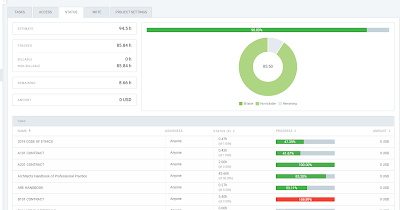
Clockify Website – I now use this website for all of my exams, to keep track of the materials I’ve studied and time spent for each resource. I can even check my progress on a daily basis, and see how many hours I study per day. This can be even better if you have specific study goals for each resource. You can use my study material tracker to list your hourly study goals for each.

Price: Free


Resources I Did Not Use

Black Spectacles – Not a lot of positive reviews and extremely expensive. I wish they broke their program into individual parts as it would be useful to try their demo exam independent of their other offerings.

Pluralsight – since Pluralsight’s PjM course is mostly contracts, I didn’t want to purchase both this and the YA Contracts course.

Brightwood – The reviews for these materials weren’t very positive, and I felt like I have enough textbooks between AHPP and Ballast.

AEP – expensive, and not enough positive reviews to purchase

Amberbooks – I didn’t get Amberbooks for this exam, but I may use it if I don’t pass my upcoming CE exam.

Young Architect Bootcamp – If I am thinking of possibly investing in this for the final 3 technical exams, if I pass Construction Administration.

In Conclusion, I’m super glad I passed this exam on the first try, and I hope you get some good out of my methods or recommended materials. If you have any questions, feel free to message me in the chat. Wanna study along with me? I’ve created a #studywithme video so you can join me for a 2 hour Pomodoro session, and not have to study alone.

ARE Master Material List

The Master Material List was a list and resource I put together to provide a comprehensive, one-stop solution for those trying to buy and understand ARE study materials. The list shows the material formats, the exams each one was used for, rental options, and prices. I have also included free materials I used within this list. You can get your copy here for free, and read along with the video replay of the live session.

I Passed PJM!

So excited to announce that I passed my project management exam just last week. This is another great step forward in my ARE journey, and thank you for following me this far. I’m still getting over my post-exam jitters. I will be sharing my detailed study list and study methods in a few days. Keep your eyes peeled for my detailed study materials blog post, try out some of my PjM practice questions, and happy studying!

What I Learned From My First ARE Exam Fail

After my recent ARE exam fail, I had a solid pity party for a few hours, then decided it would be more productive to write down what I have learned from my first failure.

Never Assume You Have Time Just Because You’re Moving Quickly

In the first half of the exam I was moving fast and doing good, I completed all of my multiple choice exams, and hit pause before going off to my break. I thought I had plenty of time. Fast forward to the end of the exam, with seconds left and still a few unanswered case study questions which I eventually just had to guess at. Time management is KEY to this exam. Don’t make my mistakes, make sure that getting through the test as a whole is your main priority and never think that you have it under control just because you made it through the multiple choice questions quickly.

Don’t Cram What You Don’t Know

Again, in studying for the exams, it is the same as taking the exams, time management is KEY. In the days before your exams, you’re going to be dealing with a lot of emotions and anxiety, don’t make this worse by trying to cram in a bunch of material you have never even looked at before. It will make you feel worse because:

  1. You’ll feel like you don’t know anything, even if you’re really strong on other topics
  2. You will get frustrated at your inability to retain this brand new information
  3. You’re dealing with exam nerves, and if you do badly on practice tests on the new material, your confidence will be shot

Make sure, well before you’re scheduled to take your exams, you’re making sure that all the topics that are going to be included in the test are a part of your study plan. Be intentional about what you’re reading, not just trying to read as much as possible. This guide on test-taking skills has a lot of helpful tips on getting prepared in advance.

Reinforce Your Weaknesses

While I wouldn’t recommend cramming new material right before an exam, I would recommend checking the information that you know that you are not performing well on. There’s a difference between trying to learn all the details of ADA clearances in one day, and having a look at your previous notes on contract documents. One involves completely learning new concepts, the other is just brushing up on what you already know.

I would say working on your weaknesses is especially important AFTER you’ve failed the exam as well. The study materials that got you a poor result may not give you success the next time around, so make sure that you are making changes to your methods or resources based off of what your previous exam was asking you. This is part of the reason why the ARE’s are called “the most expensive practice exam you’ll ever take”. Failing is part of the process, and learning from the fails is part of the process too.

One thing I’ve done is to look at multiple posts of people who have passed each specific exam, and tried to change my method based on the different content that they used. You can find passing stories on the ARE Facebook group or in the NCARB ARE 5.0 Community.

Don’t be afraid to write your own questions

In my recent exam failure, I was very frustrated with some of the practice question providers, since I felt like they failed to cover some of the very technical and graphic aspects of that exam. I was also mad at NCARB for failing to properly specify the resources that were needed to pass that exam. However, being mad at external forces won’t bring me any closer to passing the ARE.

So my recommendation is, if you feel like the questions you’re seeing on the exam are not matching the materials you are studying, feel free to write your own questions. There is literally nothing stopping you, as long as you are not copying the questions that you’ve seen in your previous ARE exams. These questions can be at whatever level of difficulty you feel comfortable with, but I have the following tips:

  1. Use the source material. If you’re writing a question on contracts, use the actual contract to write the question based on what you’ve literally read in the contract, not what Ballast, Pluralsight or Hyperfine wrote about it. This is because a lot of study resources summarize instead of writing the actual articles, which may cause you to remember the phrasing or intent clearly later on.
  2. Write why the answers are correct and why they’re wrong. This will force you to explain exactly why you’ve chosen that answer, and helps cement the concept, not just the specific answer.
  3. Share your questions! Not only does this help other people who are studying, but this also allows them to let you know if your answers are wrong and why. If people have further questions. You can share in your personal study group, which you can join through the NCARB ARE Community, in the ARE Facebook group, or with your architecture mentor, and see if they can work through the correct answer based on their professional experience.

NOMA BRAVE Breakdown

NOMA BRAVE Action Steps

For those that don’t know, the National Organization of Minority Architects (NOMA) has released some action steps for architects of all backgrounds to support their colleagues in the fight for racial justice and equity.

This initiative is called BRAVE, and NOMA challenges all large architecture firms to become dues paying members of the organization, as well adopting NOMA’s steps for an inclusive atmosphere, which include:

NOMA BRAVE Breakdown

I think this initiative is a great opportunity for those who may just be joining the fight for social injustice, but I believe that it needs a bit more detail to help with implementation. To help those who want to make a difference in the profession, but aren’t sure where to start, I’ve create the NOMA BRAVE Breakdown. This breakdown takes the action steps provided by NOMA and provides tangible next steps and goals for architecture & design professionals. Here is an image of the breakdown.

Keep in mind that the links will only work if you download the actual PDF, which is available here.

NOMA BRAVE Breakdown Image. Don’t forget that the links will only work if you download the PDF.

Disclaimer: This guide is a recommendation made by me based on the framework provided by NOMA. This breakdown was not created by or sponsored by NOMA. All thoughts and opinions contained within it are my own.

Anti-Racism Design Resources

I would also highly recommend that you check out this comprehensive list of Anti-Racism Design Resources, which cover:

Black architects, designers, planners, activists’ recent responses, reflections, statements

Firms/practices currently offering pro bono services

Firms/practices currently taking actions (e.g. matching donations)

Resources about offering pro bono services

Examples of pro bono services you and/or your firm/practice/collective can offer

Examples of fellowships/internships your firm can offer to Black students

Support Black designers, especially our colleagues, with opportunities like these!

For non-Black and white folks organizing within our firms/practices/collectives

Additional resources to share both internally and in a public statement

List of Black organizers/leadership

List of Black-led firms/practices/collectives

List of architecture/design organizations doing anti-racism work in academic institutions

List of architecture/design organizations doing anti-racism work in the field at large

List of organizations to follow on social media

Past Events

If you have any additional resources or events on this topic, feel free to share them in the comments!

Mini Quiz: A201

A 4 question quiz on the General Conditions of the Contract for Construction. The answers are provided after the questions. The A201 contract is available as a free download from the AIA website, and I’m currently studying it in preparation for my upcoming Project Management (PjM) and Construction & Evaluation (CE) Exam. It is listed within the ARE 5.0 Reference Matrix as a study material for PjM. Good luck studying, and if you have any questions, let me know in the comments!

Question 01

When does the Owner not have to share information about their financial arrangements for the Work?

  • Prior to the commencement of the work
  • When the Owner fails to make payments as per the contract documents
  • When a change in the work materially changes the contract sum
  • When the Architect issues a Certificate for Payment

Question 02

A Modification is all of the following, except for a: (Choose 1)

  • Construction Change Directive
  • Written Order for a minor change in work issued by the Owner
  • Change Order
  • Written Amendment to the Contract signed by both parties

Question 03

The Contractor shall immediately suspend any operations if they encounter the following conditions, except for:

(Choose 1)

  • Wetlands
  • Archaeological Sites
  • Burial Markers
  • Contract Documents in violation of applicable laws

Question 04

Select all items provided and paid for by the Contractor:

  • Sales Tax
  • Approvals for Occupancy
  • Temporary facilities not incorporated in the work
  • Utilities
  • Equipment and Machinery
  • Transportation

Question 01

When does the Owner not have to share information about their financial arrangements for the Work?

Correct Answers

  • When the Architect issues a Certificate for Payment

Incorrect Answers

Prior to the commencement of the work – Article 2.2.1 Prior to commencement of work and upon written request of the contractor, the owner shall furnish to the contractor evidence that the owner has made financial arrangements

When the Owner fails to make payments as per the contract documents & When a change in the work materially changes the contract sum – See Article 2.2.2

Question 02

A Modification is all of the following, except for a: (Choose 1)

Correct Answer

  • Written Order for a minor change in work issued by the Owner – Owners do not issue minor changes in work, those are issue by the Architect

Incorrect Answers

Construction Change Directive, Change Order, and a Written Amendment to the Contract signed by both parties: are all listed under Article 1.1.1 as Modifications.

Question 03

The Contractor shall immediately suspend any operations if they encounter the following conditions, except for:

Correct Answer

  • contract documents in violation of applicable laws – Article 3.2.3 The Contractor is not required to suspend work upon discovery of a nonconformity of the Contract Documents, only required to promptly report to the Architect

Incorrect Answers

According to Article 3.7.5 if the COntractor discovers any of these conditions, they shall immediately suspend operations:

  • Wetlands
  • Archaeological sites
  • Burial markers

Question 04

Select all items provided and paid for by the Contractor:

Correct Answer

  • Sales Tax – Article 3.6 Taxes
  • Temporary facilities not incorporated in the work – Article 3.4.1
  • Utilities – Article 3.4.1
  • Equipment and Machinery – Article 3.4.1
  • Transportation – Article 3.4.1

Incorrect Answers

All other items are to be provided by the Contractor.

  • Approvals for Occupancy – Provided by the owner as per Article 2.3.1

Thanks for taking part in my quiz, let me know how you did in the comments! You can also check out my mini quiz for C401 or check out my reviews for other practice exam providers.

Mini Quiz: C401

A 4 question quiz on the Agreement between the Architect and Consultant. The answers are provided after the questions. The C401 contract is available as a free download from the AIA website, and I’m currently studying it in preparation for my upcoming Project Management (PjM) Exam. It is listed within the ARE 5.0 Reference Matrix as a study material for PjM. Good luck studying, and if you have any questions, let me know in the comments!

Question 01

Select all four parties identified in the C401:

  • Architect
  • Owner
  • Contractor
  • Sub-consultants
  • Architect’s Other Consultants
  • Surety
  • Consultant
  • Subcontractors

Question 02

Which statements are true of consultant’s services?

  • COnsultant has the ability to reject work under their scope
  • Architect ascertains requirements for the Consultant’s portion of the work
  • Consultants shall render written decisions on claims and disputes relating to the execution of their portion of the scope
  • Consultant shall notify the architect of the need for additional services

Question 03

The Architect must provide the following information except for:

(Choose 1)

  • detailed layouts showing locations of connections
  • tabulations giving equipment sizes
  • the architect’s compensation within the prime agreement
  • investigations of other consultants not within the scope of the consultants services

Question 04

Select all methods of binding dispute resolution between an Architect and their Consultant:

(Choose 2)

  • Arbitration
  • Mediation
  • Professional Ethics Council
  • Litigation

Question 01

Select all four parties identified in the C401:

Correct Answers

  • Architect – Identified on the first page of the Agreement
  • Owner – Identified on the first page of the Agreement
  • Sub-consultants- Identified in Article 1.9
  • Consultant – Identified on the first page of the Agreement

Incorrect Answers

None of the other parties are specifically identified and named within this agreement.

Question 02

Which statements are true of consultant’s services?

Correct Answer

  • Consultant shall notify the architect of the need for additional services (Article 4.1)

Incorrect Answers

Article 3.1.5 Consultant does not have the ability to reject any work on the project, they can assist the architect in determining if work should be rejected

Article 3.1.1 Consultant shall ascertain the requirements for this portion of the work and shall confirm such requirements with the architect.

Article 3.1.4 Consultants don’t have the power to render decisions on disputes, they can however issue written recommendations on claims, disputes, and other matters in question relating to the execution or progress of their portions of the work.

Question 03

The Architect must provide the following information except for:

Correct Answer

  • the architect’s compensation within the prime agreement – Article 1.1, a copy of the prime agreement(from which compensation amounts maybe deleted) is attached as Exhibit A and is made a part of this Agreement

Incorrect Answers

Article 5.3 The Architect shall furnish to the Consultant detailed layouts showing locations of connections, tabulations giving equipment sizes, loads and other information on equipment designed.

Article 5.7 If the Consultant reasonably requests information from investigations, survey,s, tests, analyses or reports, or the services of other consultants not within the scope of the consultant’s services, the Architect shall request that the Owner furnish the information or services.

Question 04

Select all methods of binding dispute resolution between an Architect and their Consultant:

Correct Answers

  • Arbitration – Article 8.2
  • Litigation – Article 8.2

Incorrect Answers

  • Mediation – Not a method of binding dispute resolution
  • Ethics Council – Only related to ethics disputes against architects

Thanks for taking part in my quiz, let me know how you did in the comments!

#ARE100Challenge Day 1: Starting My Challenge

Thank you to everyone who expressed interest and support in this challenge within the ARE test taking community, especially within the ARE Facebook Group. After introducing the challenge, I thought it would be a good idea to share my own journey with using it.

My initial plan was to start the #ARE100Challenge the same day that I released it, but I decided to push it back for a few reasons:

  1. My tests, like many others, were rescheduled. As soon as the notice from NCARB regarding the cancellations, I decided, with COVID-19, that I didn’t want the additional stress of an uncertain test date on top of everything else. So my next test is scheduled for July.
  2. I have difficulty retaining information from too far back in the past. Even if I started studying now, I’m sure that I would end up forgetting a lot of the concepts I learned back in April.
  3. I wanted to take a break to reassess my priorities and get in the right mindset for studying. Rescheduling my exams took a lot of motivation out of me, and my head wasn’t in the right space.

So I am starting my countdown timer from the first day: You can find the link to my #ARE100Challenge Countdown from Day 60 here.

#ARE100Challenge Graphic. Created by RMSM Studio.

ARE 100 Challenge Countdown: 60 Days Left

HOUR COUNT: 0 OF 100 HOURS

Studying for: construction & Evaluation (CE)

challenge step: step 1. Read All required Textbooks first!

My goal for today and the next few weeks is to read as many of the main textbooks for my exam. This includes the AHPP, Ballast, and some of the Kaplan books which I’ve been able to purchase to give me a general understanding of the Construction Administration topics.

I’ve already completed the Wiley/Namour Wright Guide for the Architect’s Handbook of Professional Practice. However, tied into the concept of me losing things if I haven’t studied them recently, I would prefer to read them as second time as the last resource within this Challenge Step.

I feel like one thing this challenge allows me to do is be focused on one material at a time, instead of trying to jump from reference to reference. Cross training with different mediums is important, from audio lectures, to videos and practice exams. However, I believe cross training will come more into play once I have learned the essential concepts for this exam.

I will mainly be using the Clockify website to track my hours for this challenge, as it is a really easy interface for me to use. I’ve described how I used it to pass PcM here, along with other digital tools. I also plan on sharing a live webinar this month, on using Clockify to study more effectively for the ARE exam, so keep an eye out for that announcement.

Want to Participate in the #ARE100Challenge?

Download the Challenge Rules, and share your progress on social media using the #ARE100Challenge hashtag. Share your study materials, tips, diagrams, breakthroughs, frustrations, and successes on Facebook, Instagram or Twitter.

Record your progress and study hours daily or weekly it’s up to you!

4 Questions to Help Save Up For the ARE 5.0 Exams

I think we all got sticker shock when we first found out how expensive it would be to take these exams. For those of us with student loans, it can sometimes feel like adding insult to injury. A couple of my initial questions were:

$235 per exam? Every time? Even if you Fail? With a 50% pass rate? For Each of the 6 Exams? In this economy? With student loans? Not including study materials?

Me, in my head

But at a certain point in time, you realize that if you’ve committed to this process, you’re just going to have to get over it. If you want to be an architect, this is unfortunately the current price of entry.

So how can you save for your exams in a way that meshes with your study speed, and inclusive of possible fails? Here are the 4 important questions to ask yourself:

1. How Frequently Do You Want To Test?

How long do you think it will take you to study for each test? This will vary per person, some people willing to do it once every two weeks, and some giving themselves 1-2 months to study for each exam. My original plan was to study for 6 weeks for each exam.

There is a recommendation to study for a longer period if it is your very first exam. This can mean that you study for 2 months (8 weeks) instead, which can be great in that it allows you more time to save. You can find more information in helpful forums such as the NCARB ARE 5.0 Community or the ARE Facebook Group, that can give you more insight into how long you should study for your specific exam.

If you know that you aren’t planning to test right away, it can also be a good idea to save up a nest egg of testing funds. That way, when you finally decide to start testing, the financial aspect of it will be less of a stressor for you, and allow you to schedule retakes faster.

2. How Often Do You Get Paid?

This will vary from person to person. I personally get paid every 2 weeks. If I take an exam every 6 weeks, that gives me 3 paychecks to save up for each exam. This breaks each $235 exam into much more manageable payments of $79 per paycheck (I always round up to avoid missing some cents).

I would also recommend that you continue to keep saving even after you’ve saved enough for 6 exams. I found this very helpful video from Pluralsight when I first started testing, that explained that due to the high fail rates for the ARE, you should mentally take the cost of 3 exams and throw it away. That comes to around $705 based off the current exam fees.

This seems like a lot, because it is,. However, I think it makes a lot more sense to plan for, and save for, losing that money instead of becoming paralysed with guilt and worry when you eventually fail. Michael Riscica of Young Architect has written several great articles on dealing with failing your exams (here’s one), but just remember that the financial burden of it is something you can plan for now.

3. Will The Money Be Safe In Your Checking Account?

I don’t mean safe in that your bank may lose your money, I mean safe in that you might spend it all by accident. If you know that you struggle with financial management and personal finance in general, one of the best things you can do for your exam funds is to put it a completely separate account, ideally at a different bank.

This may seem like overkill, but I think that using this method has been one of the main reasons that I have been so successful in my exam savings.

Currently I use a separate online banking savings account, with no monthly fees, that has a 3 day waiting period before the money can be transferred back into my account. I can’t think of a better way to nip impulse buys in the bud. It is also a great feeling, when you finally take that money out, and you know you’re putting it towards something important.

4. Does Your Office Reimburse You For Passing An Exam?

Different offices have different levels of incentive for their exams. At my firm, they do not pay for the exams up front, they only reimburse you after you have successfully passed an exam that you paid for. This makes things much easier for me, in that I can take any money that I get back for a passed exam, and immediately reinvest it in a new seat credit.

There can sometimes be a temptation to go out and spend this money as a celebration for having passed, but trust me, putting it back into your NCARB account immediately is a much safer bet, and can help insure you against any hiccups in your budget down the line.

Find out what your office is willing to finance and what their policies are, in terms of sponsoring exams, books and other digital study materials. Collaborating with other people taking the exams within your office to get all the supplies you need is a great strategy to maximize your dollars spent on materials.


If you have any further questions, hit me up in the comments.