Need a fun way to stay motivated as you study for your exams? Join the #ARE100Challenge with other test takers to boost your study time and challenge yourself.
Some of the major challenges I’ve faced while studying for the ARE 5.0:
Soooo much reading, from so many different types of resources, it’s hard to keep track of it all.
No study group, and since everyone is taking a different test on a different day, it’s hard to create one with the people around you.
It’s hard to stay motivated, and the materials seem like they’ll never end.
It’s easy to get distracted by the minutia of the materials, and lose sight of the big picture.
To help myself and others experiencing these problems, I’ve created the #ARE100Challenge to bring together the ARE 5.0 test taking community, whether studying solo or with a group.
How to Participate
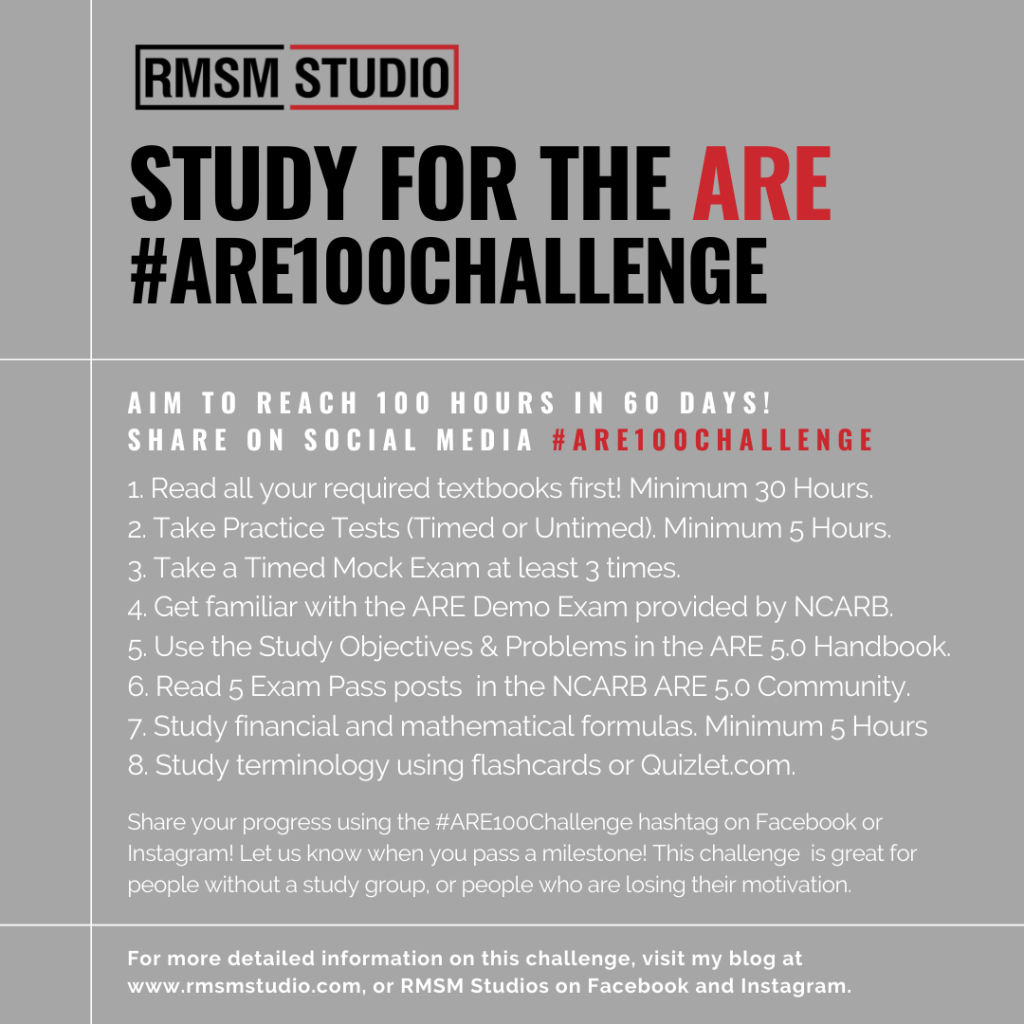
The main objective of the challenge is to complete 100 hours of studying in 60 days, regardless of which exam you’re taking.
For some this may seem like an easy target and will just provide an additional boost. However, for some test takers, this may be a serious challenge in terms of finding time to fit in studying. Wherever you are in your study plan, let’s challenge and push each other to make the most of the time we have!
The Ground Rules
1. Read all your required textbooks first! Minimum 30 Hours.
Check the NCARB Reference Matrix, NCARB ARE 5.0 Community, or the ARE Facebook Group for recommended study amterials for each test.
2. Take Practice Tests (Timed or Untimed). Minimum 5 Hours.
There are so many resources and content creators for practice tests and questions, again the forums are a great resource for recommendaitons on what will work best for the test you’re taking..
3. Take a Timed Mock Exam at least 3 times.
This can be one testing resource that you think works really well, or many different tests. The idea is that you take the completed, timed tests, review your answers, and identify the content you need to focus on.
4. Get familiar with the ARE Demo Exam provided by NCARB.
Even if you’ve taken the exam already, it is always a good idea to reaffirm the interface before you head back into your next exam. If you’ve never taken the exam, you should have an understanding of how answering all the question types work, as well as the tools available within the testing software. Did you know you can search documents?
5. Use the Study Objectives & Problems in the ARE 5.0 Handbook.
Make sure that you are covering topics within your study plan that align with the provided exam objectives within the NCARB ARE 5.0 Handbook for that specific test. Some practice tests can let you know which areas you’re weak on, so you should take the opportunity to review them.
6. Read 5 Exam Pass posts in the NCARB ARE 5.0 Community.
It’s always good to keep a positive mindset in these exams, which can have a large mental toll. A great way to do this is by reading the stories of other people who have passed the same exam recently. This has multiple benefits:
You can see what study materials and methods other successful test takers used.
It lets you know that other people are passing these tests, and that they’re not impossible.
You can ask those people questions about specific problems you are having within that same exam, while it’s fresh in their minds.
7. Study financial and mathematical formulas. Minimum 5 Hours
The math and financial portions can be very challenging for people who may not have a lot of familiarity with it within their offices. Make sure to dedicate time to memorizing the concepts relevant to your exam, so when you step into the exam, you know exactly what the question is asking for.
8. Study terminology using flashcards or Quizlet.com.
The terminology needed to pass each exam section can vary widely, which is why some prefer to study using a separate flash card deck for each exam. Flash cards are also available as physical copies. I personally like to use Quizlet.com, as it allows me to check my familiarity with each card, turn the card decks into quizzes and games, and update definitions to make them clearer. A lot of people have used Quizlet in the past to study for these exams, so you can easily find premade decks that you can use for each exam section.
Track Your Progress!
I love using Clockify.com to keep track of my studying hours, mostly because of how simple their tracking and timekeeping system is.
Another great app for tracking your time while you study on the go is the Productivity Challenge Timer App, for another layer of gamification and fun. The free version is a bit limited, which is why I normally prefer to use Clockify to track everything.
Post Your Progress!
Share your progress using the #ARE100Challenge hashtag on Facebook or Instagram, and let us know when you pass a milestone! We’re all in this together, so let’s celebrate the wins, both big and small!
If you have any questions, feel free to reach out to me here on the blog, or on Facebook or Instagram. Happy studying and good luck on your #ARE100Challenge!
When you first decide to take the ARE, you will normally go into full research mode. You treat it like a site you are doing analysis on, combing the net for study materials, handy guides, YouTube tutorials and practice questions, exam focused blog posts (guilty!), everything you can get your hands on. You assemble a treasure trove of PDF documents and a wish list full of textbooks and online courses, and you start reading. Fast forward a few hours, and you are completely overwhelmed.
The ARE is full of SO MUCH CONTENT and the sheer amount of information that you need to not just absorb, but be able to use for problem solving, can be extremely intimidating. What can be even scarier, if you’ve been working for a while in the field, is the practice of unlearning what you thought you knew, and memorizing the way that NCARB wants you practice. This can make you second guess your own memory and possibly your own professional judgement.
I got to this same point after ordering my Ballast book. I love to read, like LOVE to read, but this seemed like taking a good thing too far. There’s a difference between sitting down with a nice thick book and reading for pleasure, and sitting down with a thick book and being expected to memorize and analyze its contents.
The study guides, contracts, online resources, and the other miscellaneous PDFs I had collected and bought as part of my search for information, were also confusing. With this much data, how is it possible to prioritize and process all that I read?
This lead me to my number one rule for ARE Study Materials:
AHPP (Architect’s Handbook of Professional Practice) First! No New Study Materials Until It’s Finished!
I created this rule for myself for a few important reasons:
I have a habit of collecting a lot of data for the sake of saying that I have the information, then not reading it. This will save me a lot of wasted time in gathering studying materials that I will actually not use.
The AHPP is frequently considered required reading by those who take the exam. I’ve seen many people mention just this textbook, along with the contracts and rules of conduct, as their only required materials for passing the PcM (Practice Management Exam).
You have help in determining what is essential! Namour Wright collaborated with Wiley publishing to create very helpful guides regarding which elements of the AHPP were critical reading for each specific ARE exam.
If I can’t commit to finishing this book, there is no reason for me to be flushing additional money or time down the drain looking at less comprehensive content. The AHPP is a big book, but the information it contains is crucial information for all 6 ARE exams. It is the only reference listed in the ARE 5.0 Handbook which has content used in the development of all 6 of the exams. Check out this references page from NCARB which illustrates my point.
NCARB Reference Guide for AHPP
So even though it is important to cross train with other materials, use multiple references, and understand and read through other documents, I still put the completion of this document as my number one priority, and until you finish it, I wouldn’t put another cent into buying anything else. You can buy the AHPP on Amazon, or directly from Wiley Publishing.
There are also pre-owned copies online, and often you can already find a copy at your architecture firm, as people who have studied in your firm like to keep it around as a reference in their practice.
What text would you consider an essential item for this exam? Let me know in the comments! Happy studying!
Learn what study materials and methods I used to pass ARE 5.0 PcM on my first try.
This post was originally shared on my old blog, and has recently been updated (September 2022).
Some of the links in this post are affiliate links. This means if you click on the link and purchase the item, I will receive an affiliate commission at no extra cost to you. All opinions remain my own.
I almost can’t believe it, but the screen at Prometric confirmed it, so I’m not going to dispute it…
I passed my Practice Management (PcM) on the first try. I have been studying on and off for this exam since May last year, but I only started studying intensely for this exam since around November.
I worked full time, and organized for lunch time study sessions, where I would often be the only one to show up. I mostly studied after work, since I am not a morning person, and haven’t given up my night owl lifestyle since architecture studio. Just this week (wish I had found it earlier), I found this very informative NCARB forum post that helped give me a structure in terms of what content I should focus on, and making sure I truly understand the study materials.
My major motivator in looking for study materials was being very cost effective. I couldn’t afford to pay for a lot of fancy programs, so I just checked for the best free or cheap resources based on online and forum reviews.
To pay it forward to people like me who were desperately searching for study materials and methods for passing the exam, here is what I used.
Books
The Architects Handbook of Professional Practice (AHPP) – a critical resource and I have a separate post on my major key in terms of this resource for those taking PcM as maybe their first exam, and are wondering what materials they should focus on. The main AHPP reading guide I used was the one provided by Kevin Griendling, AIA, from Pluralsight, which I found on the NCARB forums! (more on those below) It would be pretty accurate to say that AHPP was the main physical book resource that I got for this exam. Luckily my firm had a copy in their library, so I didn’t have to shell out the big bucks! I normally aimed to read about 4 sub-chapters per day, for example, sub-chapter 1.1 to 1.4 in one evening. This worked for me as I’m normally a fast reader, and I can finish a sub-chapter in around 30 minutes.
Price: AHPP: Free for me.
Contracts
NCARB said that they only covered the B101 and C401 contracts in the PcM exam reference guide, but because people kept saying there was a lot of overlap with other exams, I studied the A201 and A101 as well, but less exhaustively.
My method for the contracts was:
Reading through the all actual contracts above at least once
Quizlet – Michael Riscica at youngarchitect.com and many others highlight the importance of flash cards and I agree! But! I feel like I am losing time writing by hand when I could be studying! And I type much faster than I write! Solution? Quizlet! It is the fastest way for me to create simple and customizable flash cards decks, with many different functions. Also usable in a mobile format which is very handy. I will be writing a longer post on my flash card studying techniques, but here you can find the decks I used:
Financial Equations with Targets Deck – most critical and helpful! I walked into the exam really knowing this information!
AIA Contracts Deck – Also very critical for ensuring you KNOW the contract numbers, and you’re not just guessing. There are other, even more comprehensive decks for contracts, with more contracts types, but for PcM, I think this one covered the essentials.
ARE 5.0 Practice Management Deck – A great resource covering terms across all aspects of PcM including some financial definitions as opposed to strictly equations.
Price for all decks: Free
NCARB Forum – Just this week (wish I had found it earlier), I found this very informative NCARB forum post that helped give me a structure in terms of what content I should focus on, and making sure I truly understand the study materials. The forums are a really great searchable resource, and I recommend that you use them when you have a specific question in terms of the best way to study specific types of content. Trust me, you’re not the first to ask. There’s no such thing as a dumb question! Some of the Forum Posts I found the most helpful were:
Tatyana Aksamentova’s Practice Management Study Guide
Tatyana Aksamentova’s Financial Ratios Study Guide
Price for Study Guides: Free
Schiff Hardin Lectures – A very important resource, that I forgot to mention in my initial release of this post was the Michael J. Hanahan, also known as Schiff Hardin lectures for AIA Contracts. These are a great resource for getting a refresher or deep understanding of the AIA Contracts, specifically the B101 and A201, for someone with lots of industry experience. These recordings can give great examples of how a particular article would play out on a real construction project. These audio recordings of his actual classes on these contracts and additional talks on risk, liability, tort, and the construction industry in general are a helpful resource. According to my productivity tracker, I studied this specific resource for at least 16 hours, normally listening during work or on long commutes or trips.
Price for Audio Lectures: Free
Practice Exams
Designer Hacks PcM Exam – A very useful resource which came in highly recommended. These questions are much easier than the exam, but I mainly used them as a resource for testing my gaps in knowledge, and didn’t really focus on my actual scores. They give explanations for why the answer is right, but not why the others are wrong, which can be a significant limitation. I liked the variety of formats, from short Pop quizzes to long Practice Exams, which helped concentrate my studying based off the time I had available.
Price: My office policy only allows one study resource purchase per person, which is normally a physical book, but instead I requested that they purchase the DesignerHacks Practice Exam Package for all 6 exams. So another Free for me! *Tip* Look into your office policies on ARE practice material sponsoring and see if you can consolidate resources for multiple tests into one.
Walking the ARE 5.0 Practice Exam – Do yourself a favor and get this exam. I did not purchase it until the day before my exam, and I feel like I could have done even better if I had. This exam comes the closest to the ARE in both the complexity and depth of the questions, and the actual exam format with the Case Studies. This is a must buy. It will give you a really good understanding of your knowledge gaps in applying the financial ratios, and the concept of time management. This is a must buy!
Price: $39. This was the only study guide I actually bought with my own money, and it was completely worth it. I recommend it highly.
Time Tracking Software
Productivity Timer App – This was the first time tracker app I used. It became critical for me to understand how much time I was putting towards which resources, and which I needed to spend more time on. My major driver on this exam was reaching 100 hours in study time, and this app was a big help in keeping me on track. The interafce is fun, and gives you levels to acheive and acheivements, similar to DesignerHacks, but this one is a bit more tongue in cheek, with levels such as Unrepentant Slacker (where I unfortunately spent most of my time). Some of the limitations of this app were the limited number of projects you could use, and it tries to discourage you from clocking time shorter than their allocated sessions (adjustable, but stays the same after you set it). Very handy in that it’s on your mobile devices and can take it anywhere and see your progress daily and since you started.
Price: Free version that I used, there is also a premium version if you need greater functionality.
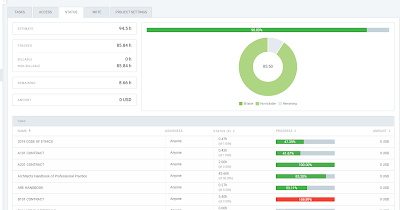
Clockify Website – This is what I ended up using after the Productivity Timer App, due to the added flexibility of time tracking. This website’s tracking function is what I normally use for staff time tracking, but if I figured that this could work easily for tracking study times. It allows you to input time that you’ve studied, or just setting a timer with your specific study resource selected. I will be making a detailed post with how I studied with this resource, but you can also check out my study status screenshot below.
Price: Free
Resources I Did Not Use
Black Spectacles – Not a lot of positive reviews for their program, and their videos are looong. They put a lot of time into their materials, but I need a more condensed version.
Pluralsight – mostly positive reviews, but not enough for me to pay for it.
Brightwood – bad reviews in forums and Young Architect website
AEP – expensive, and not enough positive reviews to purchase
Amberbooks – If I fail 1 test, I may invest in these, or maybe for the more technical exams, as structures was a long time ago for me.
Young Architect Bootcamp – If I fail more than 4 exams, I will invest in the bootcamp, too expensive for me right now
Young Architect Academy – I did not have the funds to get it in time for this exam. I will be investing in this for my PjM exam, along with the contracts course.
In Conclusion, I hope you gain some value from this long winded post. I just hope someone gets some value from my methods. If you have any questions, throw them in the comments. For now, I’m going to bed, and starting tomorrow, I’m gonna start studying for PjM.
If you got any value from this post, please let me know in the comments!
ARE Master Material List
The Master Material List was a list and resource I put together to provide a comprehensive, one-stop solution for those trying to buy and understand ARE study materials. The list shows the material formats, the exams each one was used for, rental options, and prices. I have also included free materials I used within this list. You can get your copy here for free, and read along with the video replay of the live session.




 RMSM Studio